You already know the work. The paperwork is what's holding you back.
You've been building in North Carolina for years — framing houses, running crews, finishing projects on time. But every contract you sign under someone else's license is money you leave on the table. Getting your own NCLBGC general contractor license means you can finally bid directly, collect full margins, and protect your right to file liens and enforce payment in court.
The problem isn't the construction work. It's navigating an administrative maze spread across four separate agencies — the Licensing Board, the Secretary of State, the Department of Revenue, and your local inspections department — while figuring out financial statements, surety bonds, exam logistics, and entity formation rules that no single website explains end to end.
The North Carolina General Contractor License Guide is a Licensing Navigation System — a single, plain-language roadmap that sequences every filing, fee, and deadline from LLC formation through license issuance so you submit each application correctly the first time.
What's inside the guide
The $40,000 Threshold — Know Exactly Where the Line Falls
Under N.C. Gen. Stat. § 87-1(a), any project valued at $40,000 or more requires a license. That includes labor, materials (even homeowner-supplied), subcontractor fees, permit costs, and sales tax. The guide explains what counts toward the total, why contract splitting doesn't work, and what happens to your lien rights and payment collection when you cross the threshold without a license — including the Class 2 misdemeanor criminal penalties under § 87-13.
Five Classifications, One Decision
Building Contractor, Residential Contractor, Highway Contractor, Public Utilities Contractor, Specialty Contractor — each authorizes different types of work. The guide breaks down what each classification covers, which specialty trades it includes, and why most transitioning subcontractors should pursue the Building Contractor classification even if their current work is residential-only.
Financial Responsibility — Without the $15,000 CPA Bill
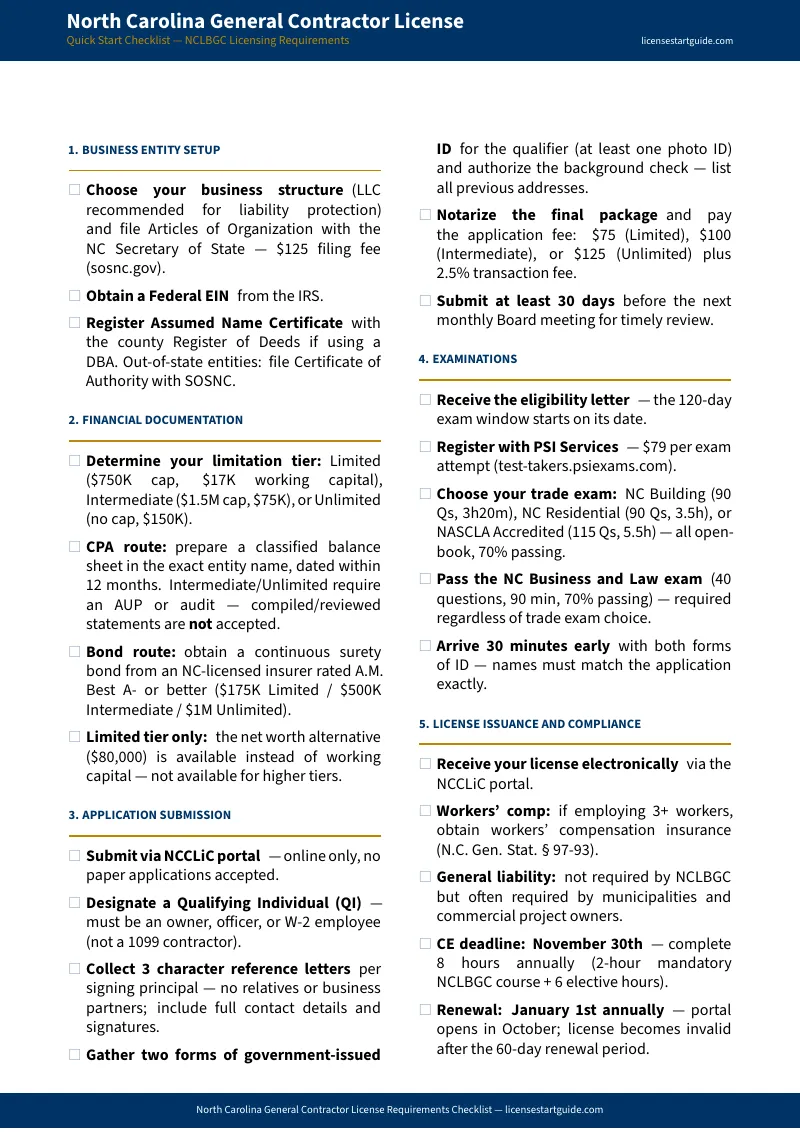
Many applicants assume they need a CPA-audited financial statement, which can cost thousands. For the Limited tier ($750,000 project cap), a simple personal financial statement showing $17,000 in working capital or $80,000 net worth is sufficient — no audit required. The guide also covers the surety bond alternative at every tier, so you can satisfy the board's financial requirements without locking up business capital.
Application Package — Step by Step
The NCLBGC only accepts online applications through its NCCLiC portal. The guide walks through LLC formation with the Secretary of State, FEIN acquisition, Department of Revenue registration, background check submission through the board's third-party vendor, character reference requirements, and the exact sequence that prevents the clerical errors delaying approvals for months.
PSI Exam Logistics and the Retake Trap
The exam is administered daily at PSI testing centers, costs $79 per attempt, and results come immediately. But your 120-day eligibility window from the Board's approval letter keeps counting through every failed attempt and every reschedule — and if the window closes before you pass, you have to contact the NCLBGC about next steps. The guide covers which reference books to bring (the exam is open-book), the difference between the state exam and the NASCLA alternative, and the retake rules that most applicants learn about too late.
Qualifying Individual Rules
The NCLBGC issues licenses to the business entity, not the individual. Your Qualifying Individual must be an owner, officer, or W-2 employee — never a 1099 contractor. If your QI leaves, you have 10 days to notify the board and 90 days to replace them before the license is invalidated. The guide covers QI agreements, disassociation procedures, and how to protect your business when personnel change.
Out-of-State Reciprocity
North Carolina has exam-waiver agreements with South Carolina, Tennessee, Georgia, Florida, Alabama, Louisiana, and Mississippi. Reciprocity waives the technical trade exam but not the 40-question North Carolina Business and Law exam, the financial requirements, or the full application process. The guide maps the complete timeline and documentation for out-of-state contractors expanding into NC.
Trade Boundaries — What Your GC License Does Not Cover
An NCLBGC general contractor license does not authorize electrical work (NCBEEC), plumbing, heating, or fire-sprinkler work (PHHFSC). Performing these trades without the correct specialty license is illegal — even on your own projects. The guide explains the legal boundaries, the solar panel exception, and how to structure subcontracts so a trade-board citation doesn't jeopardize your general contractor license.
Renewal, CE, and Staying Compliant
Licenses expire December 31 each year. The mandatory 8-hour continuing education requirement (2-hour board course plus 6 hours of electives) must be completed by November 30. The guide covers renewal fees, the reinstatement process for lapsed licenses, and disaster-relief extensions that have applied after recent North Carolina storms.
2025–2026 Code Updates
The Disaster Recovery Act of 2025 postponed the 2024 NC State Building Codes to no earlier than March 1, 2027, and the new Residential Code Council reclassified triplexes and quadplexes under the residential code. The guide explains what these changes mean for your classification choice and current project permitting.
Who this guide is for
- Subcontractors going independent — you've built the skills; the guide handles the paperwork sequence
- Under-threshold contractors — your projects are pushing past $40,000 and you need a legitimate path to scale
- Out-of-state contractors — expanding into NC through reciprocity without wasting time on requirements that don't apply
- New LLC owners — your business entity is registered but you don't know how to satisfy the NCLBGC's financial responsibility standards
- Firms replacing a Qualifying Individual — your QI left and the 90-day clock is running
Why not just use the NCLBGC website?
The Licensing Board publishes statutes, administrative codes, and application portals. But their role is regulatory enforcement, not step-by-step instruction. The board's materials don't tell you how to form your LLC before applying, don't explain the surety bond alternative in plain language, and don't warn you about the 120-day eligibility window that keeps counting through retakes.
Exam-prep schools like RocketCert and Skyline School charge $300 to $2,700 to teach you how to pass the test — but they don't cover entity formation, financial statements, background checks, QI agreements, or the municipal permit process that waits after you pass. The exam is roughly 20% of the effort. The administrative and financial groundwork that surrounds it is where most applicants stall.
This guide bridges that gap: the complete sequence from deciding to get licensed through pulling your first local building permit, in a single document that costs less than a tank of diesel.