
New York changed the rules. Most notary advice hasn't caught up.
Between 2023 and 2026, New York overhauled its notary public system — mandatory electronic recordkeeping, online-only renewals, and a permanent remote online notarization framework. But when you search for how to get your commission, you'll find county clerk pages that still reference paper renewals, vendor sites pushing surety bonds the state doesn't require, and training courses that charge $77 for exam prep that's entirely optional.
Meanwhile, one wrong file format on your NY Business Express application gets the whole thing rejected — and you lose your non-refundable $60 fee.
The New York Notary Commission Compliance Roadmap sequences the entire commissioning process so you clear each gate before spending money on the next one. It separates what the state actually requires from what vendors are selling you, walks you through every post-2023 rule change, and gives you a realistic cost-benefit analysis of whether remote online notarization is worth the technology investment.
What's Inside
- Eligibility pre-check — residency, age, and disqualification screening so you confirm you're eligible before paying the $15 exam fee
- Walk-in exam logistics — the 10 designated test centers, what to bring, payment rules (no cash accepted), and the two-year expiration window on your pass slip that most guides don't mention
- Exam exemption rules — the two statutory exemptions under Executive Law § 130 for admitted attorneys and qualifying court clerks, including what they still need to do
- NY Business Express application walkthrough — portal navigation, scanning your pass slip and Oath of Office as a single-page PDF (not JPEG — that gets rejected), and the exact steps to avoid the formatting errors that cost applicants weeks of delay
- County clerk filing map — what the DOS forwards automatically, when you need a Certificate of Official Character, and how NYC borough clerks handle things differently from upstate offices
- Supplies without the vendor markup — New York does not require a surety bond, and does not mandate a physical ink stamp as long as the required information is printed, typed, or stamped. The guide isolates the legal mandates so you don't buy a $130 "starter package" full of things you don't need
- First notarization walkthrough — a step-by-step acknowledgment procedure, the four-part identification check, and the specific errors that expose new notaries to liability
- Part 182 Journal — a printable landscape log with the required fields for every act (and extra RON columns), plus the 10-year retention rule
- Conflict-of-interest rules — which family members you cannot notarize for, when a financial interest disqualifies you, and the employer-ownership question (the commission is yours, not theirs, even if they paid for it)
- Renewal roadmap — the four-year cycle, the switch to online-only renewal on NY Business Express, and the grace period rules if your commission lapses
- RON Break-Even Calculator — Executive Law § 135-c registration, platform and certificate costs, and a fill-in volume worksheet so you can decide whether the $25-per-act fee cap actually pencils out
- Fee schedule and pending legislation — the $2 traditional cap and $25 electronic cap, plus the status of S10280 and S6268 (neither has been enacted)
Who This Is For
Administrative professionals whose employers need a notary on staff. You need to get commissioned without delays or rejected applications — and you need to know that your commission belongs to you, not the company, even if they funded the whole process.
Real estate and mortgage workers who need a commission to handle closings, deeds, and powers of attorney. You want to understand both traditional and electronic notarization so you can evaluate mobile notary work and loan signing as additional income.
Legal-support professionals — paralegals, litigation clerks, legal assistants — who handle affidavits and depositions and want the credential on their resume. You also need document authentication and Apostille procedures for international transactions.
Side-business starters building an independent notary practice. You're watching every dollar of startup cost and want to separate legal mandates from vendor upsells before you spend anything.
Why Not Just Use the Free Information?
The Department of State website has the legal requirements, but it's scattered across multiple pages of dense statutory language and doesn't tell you what to do in what order. County clerk websites are worse — many still reference pre-2023 procedures that no longer apply. And every commercial site selling stamps, bonds, and training courses has a financial incentive to make the process look more complicated and expensive than it is.
The result: new applicants routinely upload JPEGs instead of PDFs and get rejected. They buy surety bonds the state never required. They pay $77 for exam prep courses for a test based on a free booklet. They skip county clerk filing steps that leave them unable to authenticate documents in neighboring counties.
This guide doesn't sell supplies, doesn't offer training, and doesn't have a vendor relationship. It sequences the exact steps, flags the exact mistakes, and gives you the exact cost breakdown — so you spend your money on what's legally required and nothing else.
Satisfaction Guarantee
If the guide doesn't give you a clear, actionable path to your New York notary commission, email us and we'll refund your purchase. No forms, no waiting period.
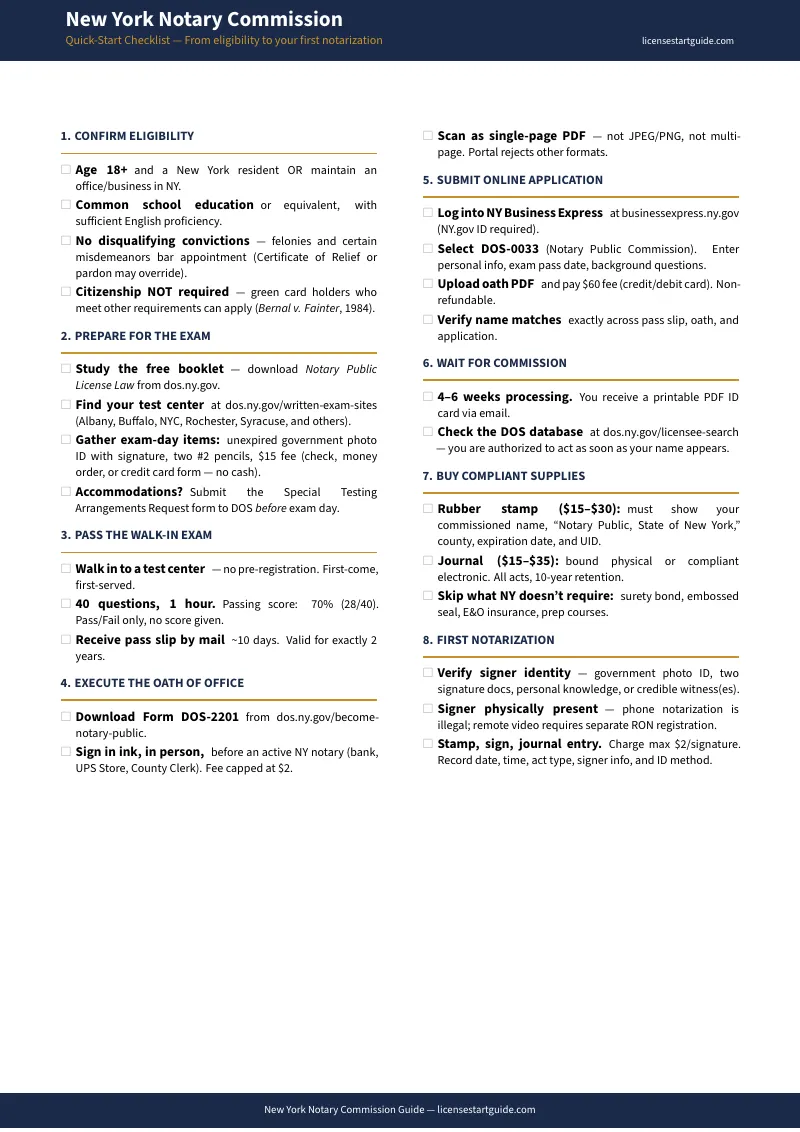
Get Started
Download the free checklist for the high-level steps, or get the full New York Notary Commission Compliance Roadmap for — the 18-chapter guide plus 10 fillable worksheets (eligibility pre-check, exam-day bag check, application prep, county-clerk tracker, supplies decision, first-act checklist, conflict screen, Part 182 journal, RON calculator, and renewal tracker).