You Have the Recipe. You Just Need the Rulebook.
You already know how to bake. You already have a kitchen full of people asking where they can buy your bread, your cookies, your green chile salsa. The part that stops you is not the cooking — it is the paperwork. Which permit do you need? Is your product even legal from a home kitchen? What happens if someone from the city shows up?
New Mexico made home food businesses easier in 2021 with the Homemade Food Act. No state permit. No mandatory inspections. No revenue cap. But "easier" is not the same as "simple." The state exemption covers food safety, but your city still wants a business license. Your county might require a zoning review. And if you are in Albuquerque, you are playing by an entirely different set of rules than the rest of the state.
The New Mexico Cottage Food & Home Food Business Guide is a Dual-Layer Compliance Roadmap — it maps both the state Homemade Food Act rules and the local municipal requirements into one sequence you can follow from your kitchen table. No bouncing between NMED, ABQ-PLAN, the Taxpayer Access Point, and four different county websites. One guide, every layer, in order.
What's Inside
- Product Classification Walkthrough — know exactly whether your recipe qualifies as a non-TCS food before you take a single order, including the acidified and fermented foods gray area that trips up salsa and pickle makers
- Food Handler Certification — which ANAB-accredited courses are accepted in New Mexico, what they cost, and how to get your card in under two hours
- Business Entity and Tax Setup — step-by-step registration for your NMBTIN through the Taxpayer Access Point, when you need an LLC, how the Gross Receipts Tax works on prepared foods, and what to file even during zero-sales months
- City-by-City Local Licensing — complete walkthroughs for Albuquerque (ABQ-PLAN), Santa Fe city and county, Las Cruces, and Bernalillo County, with fees, forms, and zoning requirements for each
- Label Templates with Exact Disclaimer Text — both the NMED statewide statement and the separate City of Albuquerque statement, plus ingredient formatting rules, sub-ingredient parenthetical format, allergen disclosure, and net weight requirements
- Farmers' Market Application Guide — permit requirements and fees for Albuquerque Growers' Markets, Downtown Growers' Market, and Farmers & Crafts Market of Las Cruces
- Sales Channel Rules — what is legal (online orders, local delivery, in-state shipping, pop-up events) and what crosses the line into territory that requires a commercial kitchen and federal registration
- Tribal Land Guidance — why NMED rules do not apply on Pueblo, Navajo, or Apache land, and how to find the right contact for your specific tribal jurisdiction
- Insurance and Liability Protection — why your homeowner's policy will not cover a product liability claim, where to get dedicated coverage starting at about $26 per month, and which markets require proof of insurance
- Commercial Kitchen Transition Path — the exact triggers that move you out of home-kitchen territory, how to find commissary space, and the permits you will need when you are ready to scale
Who This Guide Is For
- Home bakers turning a side hobby into a real income stream — you have been selling to friends and now you want to do it legally at markets and online
- Chile and salsa makers who need to understand the acidified foods rules and whether their product can be sold from home or requires a commercial kitchen
- Event vendors preparing for fiestas, pop-ups, and seasonal markets who need to clear food safety and permit requirements before the application deadline
- Anyone launching a home food business in New Mexico who does not want to pay $250 or more per hour for a lawyer to explain rules you could navigate yourself
Why Free Resources Leave You Stuck
The NMED website explains the Homemade Food Act. But it says nothing about your city's business license. The Albuquerque portal covers city permits. But it does not explain the state food safety rules. The Taxation and Revenue Department handles your NMBTIN registration. But it has no guidance on which foods are legal to sell.
Each agency covers its own slice. None of them show you how the pieces connect. You end up with fifteen browser tabs, three conflicting blog posts from 2019, and no confidence that you have found everything.
This guide connects the layers — state food safety, local business licensing, tax registration, labeling, and sales rules — into a single path. One document. Every requirement. In order.
Satisfaction Guarantee
If the guide does not help you understand your compliance path, email us at any time for a full refund. No hoops.
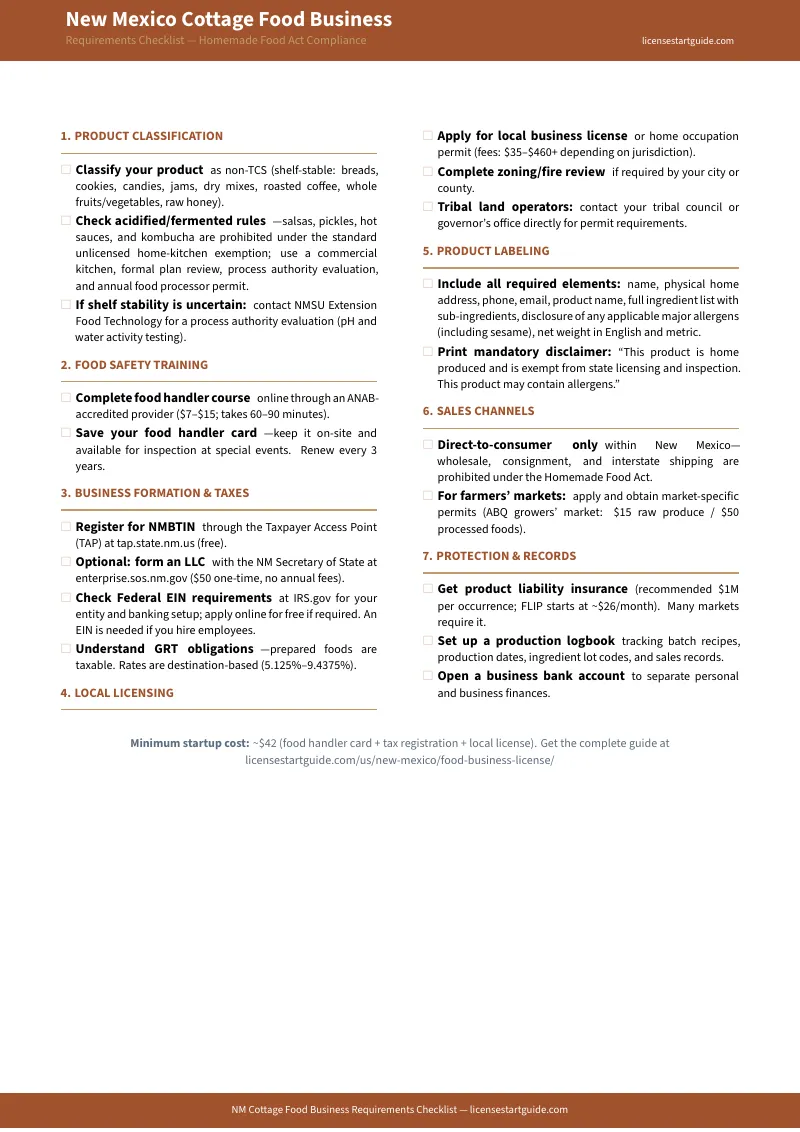
Start With the Free Checklist — Or Get the Full Roadmap
The free checklist gives you a one-page overview of every step. If you want the detailed how-to — product classification, label templates, city-specific licensing walkthroughs, tax setup, and the commercial kitchen transition guide — the full toolkit has it all. You also get 6 standalone printable worksheets: a label builder, startup cost worksheet, local licensing tracker, product classification flowchart, farmers' market prep checklist, and a regulatory contacts reference card.
Get the New Mexico Home Food Business Guide and start selling with confidence.