You Know Construction — But New Jersey's Four-Agency Regulatory System Wasn't Designed to Be Figured Out
You've spent years framing houses, managing renovation crews, or running projects under someone else's registration. You're ready to take direct residential contracts in your own name. You search "New Jersey contractor license," and what you find is a wall of conflicting information: exam-prep companies selling courses for a test that doesn't exist yet, bond brokers explaining surety products without mentioning the entity formation steps that must come first, and national licensing sites that claim New Jersey has a statewide general contractor license when it doesn't.
The reality is that New Jersey splits contractor regulation across four independent agencies — and none of them reference each other. The Division of Consumer Affairs handles home improvement registration. The Department of Community Affairs handles new home builder registration. The Department of Labor handles public works registration. The Department of Banking and Insurance handles a separate license for financed home repair contracts. On top of all that, every municipality enforces its own local permitting rules under the Uniform Construction Code, and some cities — Newark, Atlantic City, Passaic — require a separate local contractor license with their own fees, bonds, and background checks.
A single mismatched business name between your DORES entity filing, your insurance certificate, and your surety bond triggers an immediate application rejection from the Division of Consumer Affairs — and the paper-only initial filing process means you lose up to 30 days before you can resubmit.
The New Jersey Contractor Compliance Roadmap
This guide maps every regulatory track in New Jersey's construction industry and connects them in the correct sequence, so you never discover a missing prerequisite when a clerk hands your application back or a building inspector asks for a credential you didn't know existed.
Most contractors piece together compliance information from government portals that only cover their own agency's jurisdiction, insurance brokers whose articles funnel you toward purchasing maximum-limit policies, and exam-prep companies marketing $250–$400 course bundles for a state trade exam that the Board of Home Improvement and Home Elevation Contractors hasn't even designed yet. The New Jersey Contractor Compliance Roadmap gives you one document that covers all four state tracks plus the municipal layer — including the steps that look optional but are actually blocking, like the compliance bond's five mandatory statutory clauses that get bonds rejected when surety brokers leave them out.
What's Inside
- The Four Regulatory Tracks — clear decision criteria for HIC registration (existing residential, $500+ contracts), HECB registration (structural elevation), New Home Builder registration (100% new construction), and Public Works Contractor Registration (government-funded projects), so you apply for the right credential and skip the ones you don't need
- Entity Formation and the Name-Match Sequence — LLC or corporation filing through DORES ($125), Federal EIN, NJ-REG tax registration, and the exact order that prevents the name-mismatch rejection that delays processing by up to 30 days
- The HIC Application Walkthrough — the paper-only filing procedure at 124 Halsey Street in Newark, the $110 initial fee, owner disclosure requirements for anyone holding 10% or more equity, criminal history documentation, and the 30-day processing timeline
- The Compliance Bond Sliding Scale — Tier 1 ($10,000 bond, $75–$100 premium), Tier 2 ($25,000), and Tier 3 ($50,000), with the Bond Language Verification Worksheet that checks all five mandatory statutory clauses before you submit
- Insurance Requirements Decoded — $500,000 per occurrence CGL for HICBs, $1,000,000 for HECBs, workers' compensation under N.J.S.A. 34:15-1, the sole proprietor exemption process, and the exact certificate holder wording the DCA requires
- The State-vs-Municipal Split — why your state HIC registration doesn't substitute for local permits, with specific requirements for Newark (building contractor license, police background check, 1% payroll tax), Atlantic City (Class I/II licensing, $1,000,000 minimum liability), and the Uniform Construction Code permit workflow
- Specialty Trade Boundaries — when electrical, plumbing, and HVACR work requires a separate state-level license from its dedicated board, and the scope-of-practice rules that determine whether an HIC registration covers your work
- New Home Builder and Warranty Registration — the Department of Community Affairs program, the $200 fee, NJ Directive 15 land-ownership verification, and the new online warranty portal that launched January 2026
- The 2023 Licensing Act Timeline — exactly what's enforced now (compliance bonds, criminal disclosures) versus what's deferred (trade exams, experience requirements), the five-year grandfathering threshold, and why registering under current rules is simpler and cheaper than waiting
- Contract Compliance Audit — the N.J.A.C. 13:45A-16.2 requirements for residential contracts over $500, including the 10-point typeface mandate, explicit start and completion dates, written change order clauses, and the mandatory 3-day right of rescission
- Eight Printable Planning Tools — the Regulatory Track Decision Flowchart, the Entity-Insurance-Bond Sequence Tracker, the Registration Application Tracker, the Bond Language Verification Worksheet, the Contract Compliance Audit Worksheet, the Insurance Coverage Tracker, the Municipal License Research Log, and the Agency Communication Log — so every filing, fee, and document requirement stays on paper
Who This Is For
- Transitioning subcontractors — experienced tradespeople who have worked under a prime contractor's registration and are registering independently to take direct residential contracts exceeding the $500 threshold
- Non-trade specialists getting compliant — painters, handymen, landscapers, and flooring installers who have been operating without realizing that their work triggers state HIC registration requirements
- Business entity restructurers — sole proprietors or partnerships transitioning to an LLC or corporation who need to re-register under the new entity without invalidating their insurance and bond coverage
- Out-of-state contractors entering New Jersey — New York, Pennsylvania, and Delaware crews who just discovered that New Jersey offers no general reciprocity and their home-state credentials are unrecognized
Why Not Free Online Resources?
The official government portals are accurate — for their own agency. The Division of Consumer Affairs explains HIC registration without mentioning entity formation or tax registration. The Department of Community Affairs covers new home builders without referencing the home improvement program. National compliance sites like Harbor Compliance and API Processing deliver high-level overviews that funnel you into $300–$1,000+ filing service packages. Bond brokers explain their surety product without detailing the five statutory clauses that the DCA actually checks. Insurance companies sell maximum-limit policies without mentioning the sole proprietor workers' comp exemption that might save you thousands annually.
Then there are the exam-prep companies marketing $250–$400 study bundles for a New Jersey trade exam that the state hasn't built yet. The 2023 Licensing Act deferred testing requirements until two years after the Board is fully seated — and the Board was only partially formed in July 2025. Buying exam prep in 2026 for a test that won't exist until 2027 or later is wasted money.
This guide connects all of it — every state agency, every regulatory track, and the municipal layer — in one document, in the right order, with every requirement verified against current New Jersey statutes and administrative code.
Satisfaction Guarantee
If this guide doesn't save you time navigating New Jersey's contractor compliance system, email us and we'll make it right.
Get Started
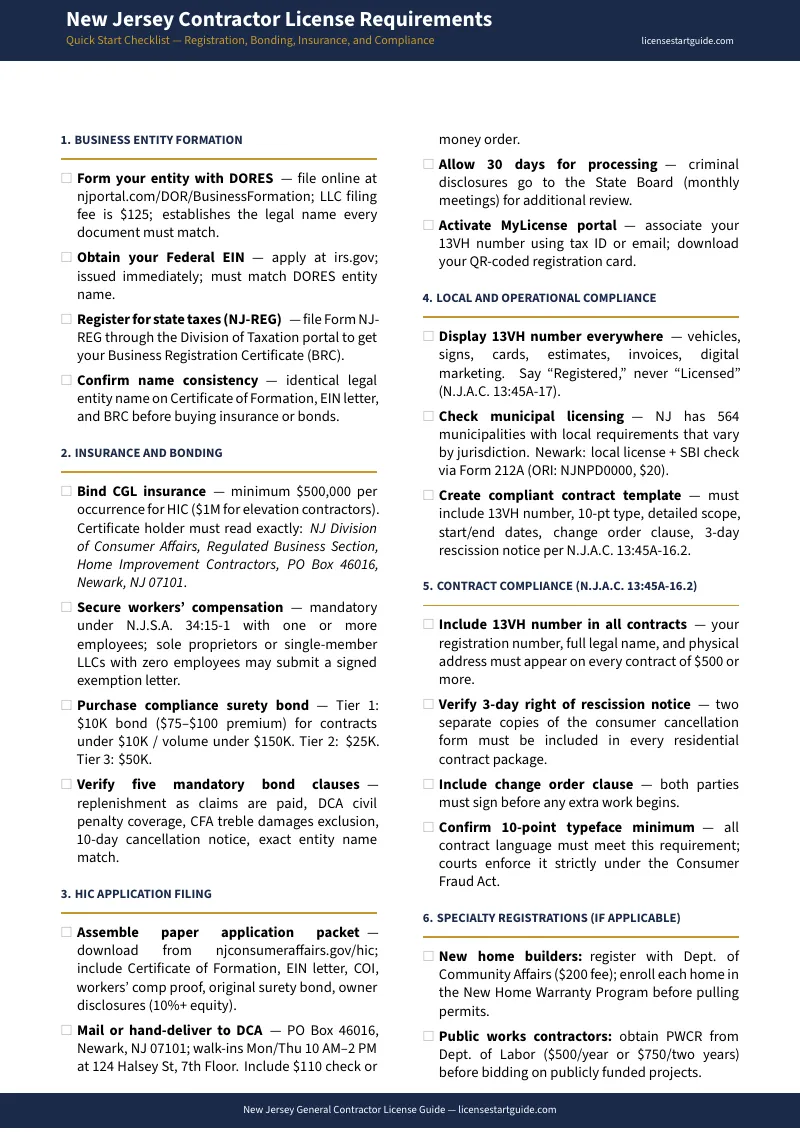
Download the free checklist to see the full registration sequence at a glance — entity formation, insurance and bonding, the HIC application, and local compliance steps. Ready for the complete walkthrough with the compliance bond sliding scale, five mandatory statutory bond clauses, specialty trade boundaries, the 2023 Licensing Act timeline, and all eight printable planning tools? Get the full guide for .