Before you pay $425 to register, make sure your recipes are actually legal to sell from home
Nevada lets you sell homemade food from your kitchen — but the rules are scattered across five different health authorities, each with its own application portal, fee schedule, and local restrictions. Clark County requires an in-person food handler card. Washoe County bans sourdough. Carson City offers free registration while some districts charge over $100. And the line between cottage food, craft food, and "you need a commercial kitchen" is exactly where most new operators get it wrong.
The typical home food entrepreneur spends $600 or more before selling a single item: $425 for LLC formation through SilverFlume, plus county registration fees, a DBA filing, liability insurance, and a sales tax permit. If your signature recipe turns out to require a commercial kitchen — cream cheese frosting, meringue filling, any meat product — that investment is wasted before you start.
The County Compliance Navigator
This isn't a generic overview of cottage food law. The Nevada Cottage Food & Home Food Business Guide is a county-by-county compliance navigator that maps every step from recipe validation to your first legal sale — tailored to whichever of the five health authorities covers your address.
Most guides tell you "register with your local health authority." This one tells you which authority, how to apply (email submission at SNHD, the onenv.us portal at NNPH, the Aithent system at DPBH), what it costs, and which local rules apply to your specific recipes — because a product that's legal in Clark County might be prohibited in Washoe County.
What's Inside
- Recipe eligibility decision matrix — run your ingredients through a shelf-stability checklist before spending money on registration. Know in minutes whether your product qualifies as cottage food, needs craft food registration with the NDA, or requires a commercial kitchen.
- County-by-county registration walkthroughs — step-by-step filing instructions for SNHD (Clark County), NNPH (Washoe County), CCHHS (Carson City/Douglas), CNHD (Churchill/Mineral/Eureka/Pershing), and DPBH (all remaining rural counties). Portal URLs, email addresses, fee schedules, and processing timelines for each.
- Label compliance templates — pre-formatted layouts with the exact 10-point warning text required by NRS 446.866, allergen disclosure formatting for all nine major allergens, and the ingredient-list rules that trigger label rejections at SNHD review.
- Craft food exam and pH testing guide — the full process for NDA registration: exam locations (Sparks, Elko, Las Vegas), fees, what's on the test, how to get recipes reviewed by a Process Authority, batch pH testing procedures, and the five-year log-keeping requirement.
- Business formation roadmap — SilverFlume filing instructions, the sole proprietor exemption for businesses under $27,000, sales tax permit registration, DBA filing, and the insurance coverage you need before a farmers market will let you set up a booth.
- AB 352 transition tracker — what changes on July 1, 2027 (higher revenue cap, online sales, unified NDA oversight) and what stays the same today. Built so you can plan for the new rules without accidentally violating the current ones.
- Farmers market and sales venue checklist — what to bring, what documentation market managers will ask for, packaging requirements, and the registration letter you need from your health authority.
- Scaling triggers reference — the specific signals that mean you've outgrown cottage food rules and need to transition to a commercial kitchen, with cost estimates and a timeline for making the switch.
Who This Is For
- Home bakers planning to sell at farmers markets, community events, or directly to neighbors
- Meal prep entrepreneurs who need to know whether their recipes qualify for home production or require a commercial kitchen
- Pickle, salsa, and sauce makers navigating the craft food registration process with the NDA
- Side-hustle food sellers who want to stay legal without hiring an attorney or spending days on government websites
- Existing cottage food operators who need to understand the AB 352 changes coming in 2027
Why Not Just Google It?
You can find bits and pieces across five different agency websites, each covering only its own county. The SNHD site explains Clark County rules but says nothing about business formation. Forrager's national directory gives a decent overview of NRS 446.866 but misses local variations like Washoe County's sourdough ban. RestauNax incorrectly tells Nevada operators they can use nationwide shipping — which is illegal under current law and would trigger enforcement.
The guide consolidates these fragmented sources into one reference that covers every county, every pathway (cottage, craft, and commercial), and every step from recipe to revenue — verified against the actual statutes, not scraped from outdated blog posts.
Satisfaction Guarantee
If the guide doesn't help you navigate Nevada's home food regulations more clearly than what you've found online, email [email protected] and we'll sort it out.
Get Started
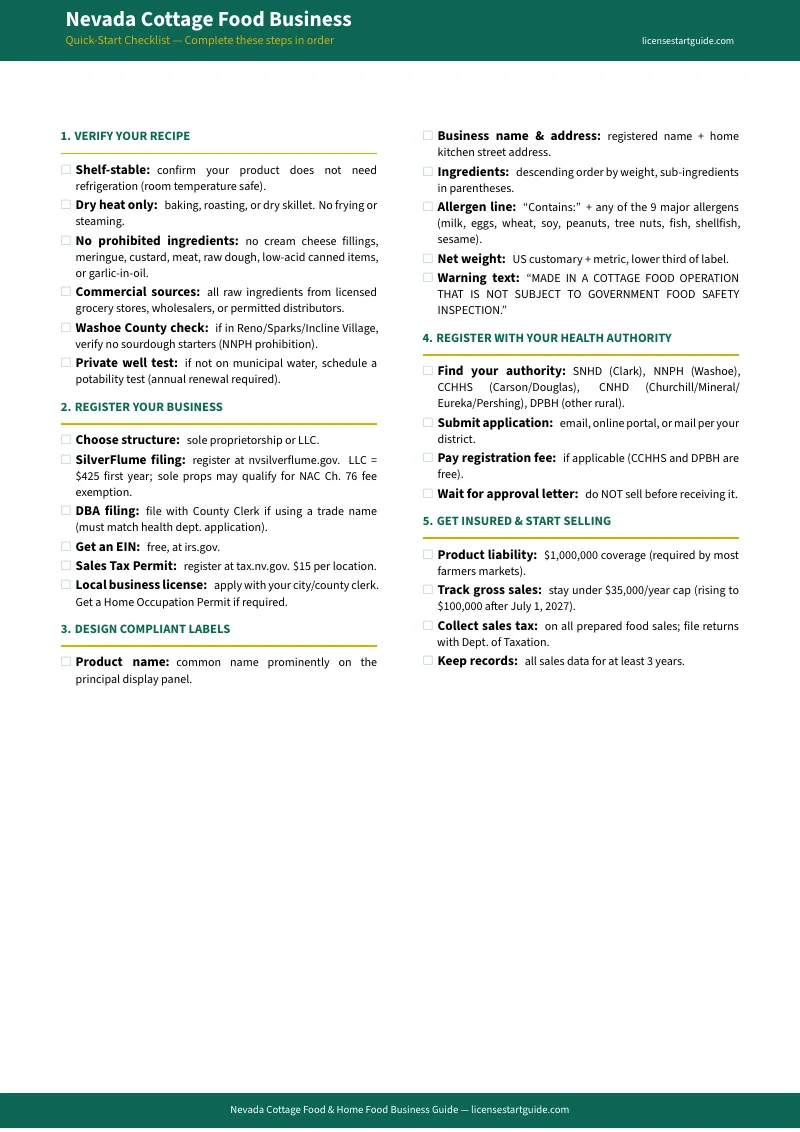
Download the free checklist to see the startup steps at a glance — or get the full guide for with 7 PDFs: the complete guide, a quick-start checklist, plus 5 standalone printable worksheets — recipe eligibility matrix, label compliance template, AB 352 transition tracker, farmers market checklist, and scaling triggers reference.