
You're About to Pay Hundreds in Fees Before Knowing If Your Home Qualifies
You've decided to open a licensed home daycare in Michigan. You've found the CCHIRP portal, you know there's a background check, and you've heard the orientation is mandatory. What nobody tells you is the order those things need to happen in — and how much money you'll waste if you get the sequence wrong.
Here's what typically goes wrong: you submit your CCHIRP application and pay the $50 state fee. Then you schedule fingerprint appointments for every adult in your household at $64.25 each. Then you hire a heating contractor to inspect your furnace. Then you find out your township requires a special land-use permit for group homes, or your landlord's lease prohibits commercial activity, or the lowest level of your home has radon above 4.0 pCi/L and mitigation runs $1,000 to $3,000. Every dollar you spent before that discovery is gone.
The Capital-Protection Sequencer
This is a 12-chapter guide built around one principle: never pay a non-refundable fee before your home is cleared to proceed. The first steps cost nothing — you verify zoning, lease or HOA restrictions, indoor space measurements, exit dimensions, and household member eligibility before the state sees a dollar. Background checks, inspections, and training come only after the free feasibility filter confirms your home qualifies.
The guide covers the 2026 MiLEAP licensing rules (filed April 27, 2026 — the biggest update in a decade), the CCHIRP and CCBC portal workflows, and the local zoning variations that trip up providers in cities versus townships. It is not a summary of the state website. It is a sequenced plan that tells you exactly what to do, in what order, and why that order protects your money.
What's Inside
- Feasibility-first sequencing — the first two chapters cost you nothing. You verify your local zoning status, lease or HOA restrictions, indoor space minimums (35 sq ft per child), exit window dimensions, and radon levels before paying any state fees. If your home can't pass, you find out before you're invested.
- License category decision guide — the difference between a Family Child Care Home (1–6 unrelated children) and a Group Child Care Home (7–12), including the 1,500-foot spacing rule for group homes, mandatory assistant requirements, and how your own children under 6 affect your licensed capacity.
- CCHIRP application walkthrough — step-by-step portal registration through MiLogin, application submission, and fee payment ($50 family, $100 group). Includes what triggers the Launch Letter and how to read the codes it contains.
- Background check filing guide — how to register in the CCBC system, schedule Idemia/IdentoGO fingerprinting for every household member aged 14+, handle out-of-state history checks within the 45-day window, and pre-screen against disqualification standards before paying the $64.25 per-person fee.
- Training and certification map — mandatory pre-licensing orientation through MiAEYC Knowledge Center, MiRegistry setup, Health and Safety Training, Safe Sleep Practices, pediatric CPR/First Aid certification, and the medical clearance form (CCL-3704). The 2026 rules eliminated TB testing — the guide reflects what's current.
- Inspection prep by category — smoke and CO detectors on every floor, 2A-10BC fire extinguishers mounted at the right height, emergency exit dimensions, outlet covers, hazardous material storage, window cord anchoring, outdoor play area fencing, and impact-absorbing surfacing. Organized to match the BCAL-4601 Compliance Record so you can pre-audit room by room.
- Environmental testing requirements — radon testing thresholds, private well water testing (coliform, nitrates, arsenic, lead, copper), heating and water heater inspection requirements for fuel-fired systems, and when all-electric homes are exempt.
- Ratio and capacity tables — age-based child-to-staff ratios (1:4 for infants under 12 months), how your own children count, mixed-age group calculations, and the pathway to a capacity variance after 29 consecutive months of incident-free operation.
- Zoning by municipality type — how the Michigan Zoning Enabling Act (MCL 125.3206) protects family homes as a residential use by right, which cities and villages can require home-occupation permits, and the local signatures needed for the group home Zoning Approval Form (CCL-3748).
- Subsidy enrollment walkthrough — step-by-step registration for the Child Development and Care (CDC) program, SIGMA VSS setup for electronic billing, Form DHS-4025 submission, Tri-Share employer-based care, and Great Start to Quality star ratings.
- Startup budget breakdown — a line-by-line cost estimate covering state fees, background checks, training, fire equipment, insurance ($500–$2,000/year for commercial liability), local permits, and environmental testing, so you can plan your runway before you commit.
Who This Is For
Stay-at-home parents starting a home-based income. You want to earn while caring for your own children, but you need to understand how your kids affect licensed capacity, what the household background check means for other adults in your home, and which steps to complete before you risk any money on an application that could be denied.
Career-changing educators. You know child development and classroom management inside and out, but you've never navigated municipal zoning, scheduled fingerprinting through a state portal, or built a client base from scratch. This guide handles the business and licensing infrastructure so you can focus on the childcare.
Informal caregivers crossing the licensing threshold. You're already watching a few kids and another family just called. Going licensed means state inspections, background checks, and formal record-keeping — but it also means higher subsidy reimbursement rates through the CDC program and the ability to grow. This guide gets you through the transition without guesswork.
Why Not Just Use the Free State Resources?
MiLEAP's website has the administrative rules, the application portal, and dozens of PDFs. It does not tell you which requirements to complete first, how to coordinate the state application with your local zoning office, or how to pre-screen your household members before paying for fingerprinting. It's a reference library, not a sequenced plan.
Our Strong Start (OSS) offers free one-on-one consulting through assigned navigators — scheduled meetings focused on active applicants who are already in the system. They don't provide a self-paced, offline planning sequence you can work through before committing to the process.
Brightwheel and Wonderschool publish compliance overviews to drive software adoption. Their articles are frequently outdated, don't reflect the April 2026 rule changes, and skip local zoning and property-level feasibility entirely.
This guide fills the gap: a one-time purchase that sequences every step from feasibility through your first enrolled families, built on the current 2026 rules, then gets out of your way.
What You Get
Your download includes 9 printable PDFs:
- The full guide — 12 chapters covering license categories, property feasibility, ratios and capacity, the CCHIRP application process, background checks through the CCBC system, training and certifications, home inspection prep, the licensing inspection and renewal cycle, subsidies and revenue programs (CDC, Tri-Share, Great Start to Quality), startup costs, worksheets, and a key resources directory.
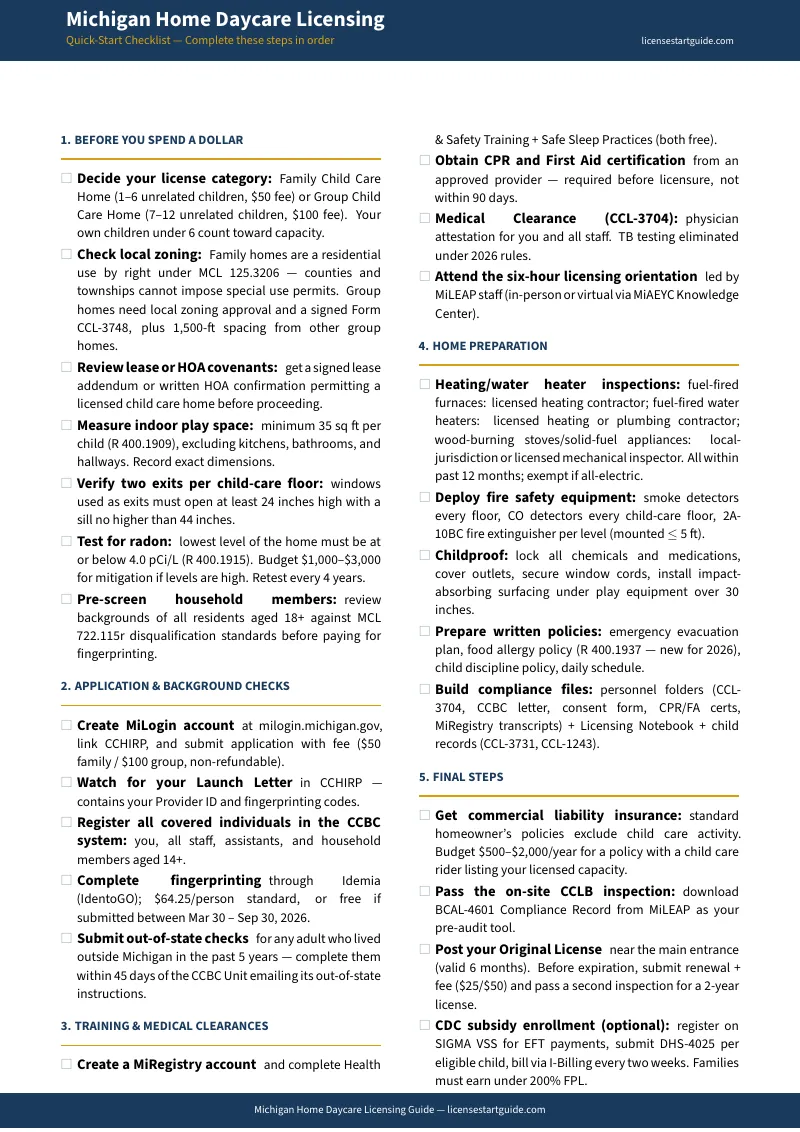
- Quick-start checklist — 26 items organized by phase, from zoning verification through CDC subsidy enrollment, with chapter references so you can jump to the full explanation for any step.
- Property feasibility worksheet — five gates to verify zoning, lease/HOA approval, indoor space, exits, and environmental testing before you spend anything on state fees.
- Background check tracker — tracks every household member and staff person through CCBC registration, fingerprinting, and out-of-state registry checks.
- Startup budget worksheet — line-by-line cost tracking with typical ranges for state fees, inspections, safety equipment, training, and insurance.
- Training and certification tracker — logs completion and expiration dates for pre-licensing orientation, CPR/First Aid, medical clearance, and annual professional development.
- Inspection preparation checklist — organized to mirror the BCAL-4601 Compliance Record so you can pre-audit your home room by room before the licensing consultant arrives.
- Agency communication log — documents every call, email, and visit with MiLEAP, your zoning office, county health department, and Idemia — your proof if anything is disputed.
- CDC enrollment tracker — tracks each subsidized child's DHS-4025 submission, authorization, approved hours, co-pay, and bi-weekly I-Billing submissions.
Satisfaction Guarantee
If the guide doesn't help you move forward, email us and we'll refund you. No time limit, no hoops.
Download the free checklist to see the structure. When you're ready for the full sequenced guide, the paid version is waiting.