Your Recipe Is Ready. Maine's Paperwork Isn't.
You've nailed the recipe. Friends and neighbors keep asking where they can buy it. But between the DACF application, the kitchen inspection checklist, the municipal zoning codes, and the sales tax portal, "start selling" turns into a months-long scavenger hunt across half a dozen government websites that don't reference each other.
Maine doesn't run home food production through one simple cottage food law. It runs it through two entirely separate systems — state licensing under the Department of Agriculture, Conservation and Forestry and a network of 113+ Food Sovereignty Ordinances that exempt direct sales from inspection entirely. Applying under the wrong framework wastes weeks. Skipping the one you actually need risks operating illegally.
The Regulatory Convergence System
The Maine Cottage Food & Home Food Business Guide is a step-by-step process navigator that walks you through every agency, form, and filing in the order you actually need to complete them. It synthesizes the state DACF licensing requirements, municipal zoning codes, the Maine Tax Portal, and the University of Maine process authority review into one chronological sequence — so you don't discover halfway through that your town requires a separate home occupation permit or that your product triggers the 8% prepared food tax.
What's Inside
- Three-Pathway Decision Matrix — a structured flowchart that tells you whether you need a $20 state Home Food Processor License, can operate under your town's Food Sovereignty Ordinance, or require a commercial facility, based on your product type, location, and sales channels
- Kitchen Inspection Readiness Checklist — the exact items the DACF inspector checks (handwashing station, dishwashing setup, surface materials, pest controls, storage separation) so you can self-audit before scheduling the official visit
- Label Templates with Allergen Formatting — ready-to-use layouts covering the mandatory elements: product name, physical address, dual-unit net weight, ingredients in descending weight order, and the "Contains" allergen statement for all nine major allergens
- Municipal Zoning Breakdowns — specific requirements for Portland (Type A/B permits, the 51% prepared food rule), Lewiston (the Tier 1 bakery exemption), Bangor (Food Sovereignty license application), Windham (buffer rules and septic filing), and Farmington (Certificate of Occupancy process)
- Acidified Food Testing Protocol — step-by-step instructions for submitting recipes to the University of Maine Cooperative Extension, including sample sizes, formatting, pH monitoring, and current testing fees
- Sales Tax Classification Framework — a clear breakdown of which products qualify as tax-exempt grocery staples, which trigger the 8% prepared food rate, and exactly how the 75% threshold rule works when your product mix crosses the line
- Two Worked Cost Examples — total startup costs calculated for a home baker on municipal water and a salsa producer on a private well, covering license fees, water testing, process authority review, insurance, and business registration
- Six Printable Planning Worksheets — pathway decision, inspection readiness, label compliance, production batch log, startup cost calculator, and agency communication tracker — each a separate fillable PDF you can print and use immediately
Who This Is For
- Home bakers who want to sell at farmers' markets, local shops, or online within Maine without renting commercial kitchen space
- Jam, preserves, and salsa makers who need to understand when a recipe requires a process authority review and when it doesn't
- Homesteaders selling value-added products like honey, maple syrup, herb blends, or roasted coffee from their farm or homestead
- First-time food entrepreneurs figuring out the difference between a DBA at the municipal clerk's office, an LLC with the Secretary of State, and a sales tax certificate on the Maine Tax Portal
Why Free Resources Leave You Stuck
The DACF website tells you how to apply for a license. It doesn't tell you how to check whether your town's zoning code even allows a home food business. The University of Maine Extension runs excellent food safety workshops, but they don't cover business formation or sales tax. Forrager and Cottage Food License give you a national overview, but they don't explain that Portland's 51% rule can reclassify your entire sales operation or that Lewiston's 2025 zoning reform created a Tier 1 bakery exemption that didn't exist two years ago.
Each of these sources covers one slice of the process. None of them tells you the sequence — which agency to contact first, what to prepare before the inspection, and which filings depend on which approvals. The guide puts the sequence together.
The Free Checklist
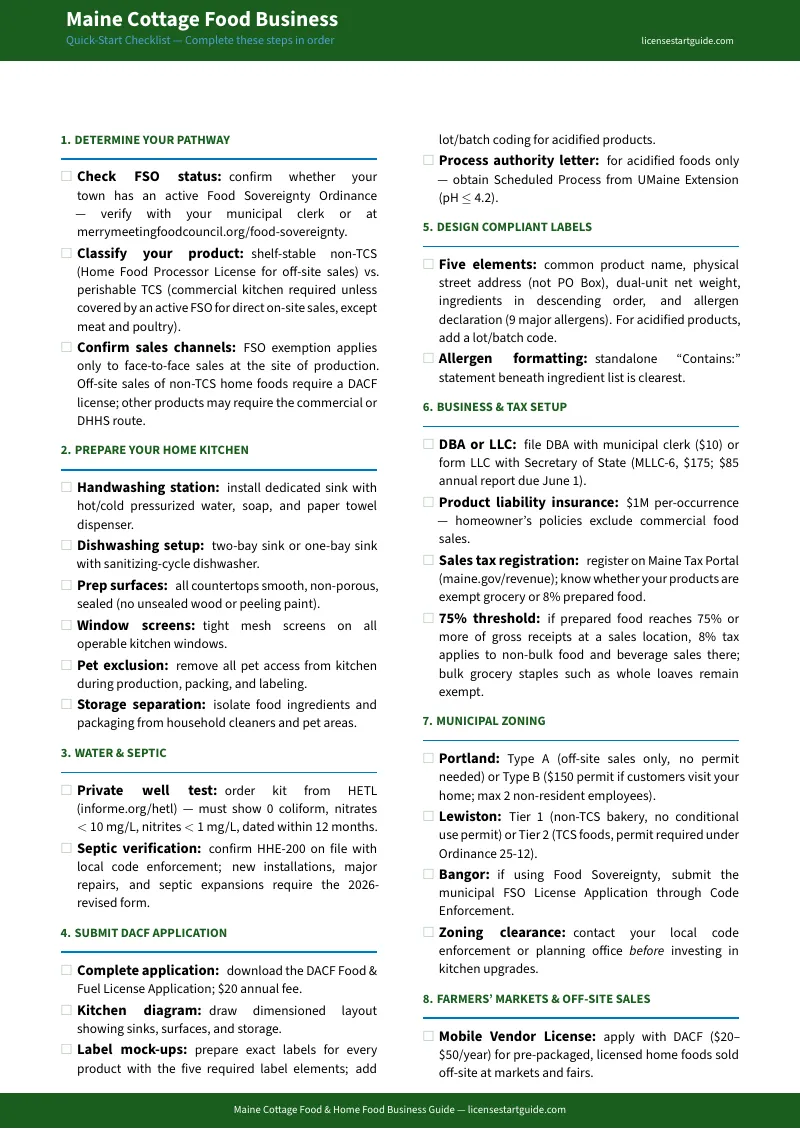
Not ready for the full guide? Download the Maine — Cottage Food Business Requirements Checklist — a printable rundown of the key steps, from pathway selection to kitchen preparation to DACF application to sales tax registration. It covers what to do. The full guide covers how.
100% Satisfaction Guarantee
If the guide doesn't help you understand the licensing process, email [email protected] at any time for a full refund. No forms, no hoops.
Your recipes are already good enough to sell. The only question is whether you'll spend weeks piecing together the regulatory process from scattered government sites — or follow a step-by-step guide that puts it all in order for .