One Out-of-Order Step Forfeits Your Non-Refundable Fees. One Lapsed Bond Suspends Your Commission.
Louisiana's notary commissioning process is the most demanding in the country. Unlike the quick online applications most states offer, Louisiana requires non-attorney notaries to pass a five-hour written civil-law exam administered by LSU — with a historical pass rate between 10% and 25%. Before you can even register for that exam, you have to navigate a sequence of overlapping state deadlines: the Application to Qualify must be submitted at least 37 days before the test, the LSU pre-assessment must be completed and graded before the Secretary of State will approve your exam registration, and the exam registration itself closes 30 days before the sitting date.
Get the sequence wrong — submit the application too late, register before your pre-assessment score transmits, or miss the parish clerk filing deadline after you pass — and you forfeit non-refundable fees, delay your commission by months, or face automatic suspension. The Secretary of State's website provides the rules, but it doesn't sequence them. The forms are there, the fee schedule is there, the exam dates are there — scattered across separate portals with no roadmap connecting them.
Then there's the 2026 bond change. House Bill 259 (Act 258 of 2025) raised the mandatory surety bond from $10,000 to $50,000 and eliminated E&O insurance as a filing substitute. If you were commissioned under the old rules, your commission is at risk of automatic suspension when your bond term expires. New applicants need to budget for the higher bond premium from day one.
The Filing Sequence System — Every Deadline Mapped Before You Spend a Dollar
This guide is built around the interlocking deadlines that catch Louisiana notary applicants off guard. Instead of listing requirements and leaving you to figure out the order, it maps every step so you complete each prerequisite before the next deadline window opens. You submit the Application to Qualify before the 37-day cutoff. You complete the pre-assessment before registering for the exam. You secure the $50,000 bond before filing your commission package. You file the duplicate oath with your parish clerk within 30 days of taking office.
The Filing Sequence System turns Louisiana's multi-agency, deadline-driven pipeline into a single linear path — so you spend money only when you're certain each gate is cleared.
What's Inside
- Pre-Qualification Walkthrough — Eligibility requirements (age, citizenship, voter registration in your parish), the $35 Application to Qualify, and the critical 37-day pre-exam deadline that most applicants don't realize exists until it's too late. The guide explains exactly when to submit so you don't miss the next exam cycle.
- LSU Pre-Assessment Navigator — Step-by-step guidance on the mandatory $30 online pre-assessment through LSU's Office of Testing & Evaluation Services, including what the test covers, how scores are transmitted to the Secretary of State, and the timing coordination that must happen before you can register for the exam.
- Exam Registration and Logistics — The $100 registration fee, exam-day proctoring rules at LSU's testing centers, permitted study guide tabbing methods for the open-book test, managing the five-hour testing window, and what happens if you need accommodations or a retake (each attempt requires a new $100 fee).
- Bond Acquisition Under Act 258 — How to purchase a compliant $50,000 corporate surety bond, typical premiums (around $110–$250 for a five-year term), the $20 state filing fee, why E&O insurance no longer counts as a substitute, and the exact filing steps to avoid the commission suspensions the Secretary of State is actively issuing for non-compliant bonds.
- Dual-Level Oath and Commission Filing — Executing the Oath of Office and Official Signature Page, filing the complete commission package with the Secretary of State ($35 fee), and the 30-day deadline to file a duplicate oath with your parish Clerk of Court. Missing the parish filing doesn't void your commission immediately, but it creates administrative delays that can hold up your commission certificate.
- Notarial Authority and UPL Boundary Map — The documents you can draft under Louisiana's civil-law system (cash sales, wills, acts of donation, mortgages, successions, corporate formations) and the line where non-attorney notaries cross into unauthorized practice of law under R.S. 37:213. Louisiana's notary authority is broader than any other state's — and the consequences for overstepping are correspondingly severe.
- Remote Online Notarization Setup — The separate RON authorization process: holding a traditional commission first, completing an approved training course, contracting with a Secretary of State-approved platform, obtaining electronic seal and digital signature certificates, and the physical-presence-in-parish requirement during live sessions.
- Commission Maintenance and Parish Transfer — Lifetime commission duration, five-year bond renewal cycles (with the new $50,000 threshold), what triggers automatic suspension, and the full transfer process if you move to another parish — including the new qualifying application, commission fee, bond rider, and duplicate oath filing.
- Complete Cost Summary — Every mandatory fee itemized: $35 application, $30 pre-assessment, $100 exam, $100 study guide, $35 commission, $20 bond filing, plus bond premium and optional supplies. Budget the full pipeline before committing to the first step.
Who It's For
- Legal-support professionals — paralegals, title clerks, and law-firm office managers whose employers need someone commissioned to execute authentic acts in-house. The exam is the hardest notary test in the country, and a missed administrative deadline reflects directly on your professional capability. The guide sequences every filing so you don't waste time or money.
- Real estate and title workers — closing agents, loan officers, and transaction coordinators who need a commission to handle property transfers and mortgages. You also need to understand whether RON authorization makes sense for your transaction volume, without being funneled through a platform vendor's sales pitch.
- Side-business starters — mobile notary operators and loan signing agents building a practice around Louisiana's uniquely broad notarial authority. You're funding every fee out of pocket and need to separate the mandatory state costs from optional vendor markups before committing several hundred dollars.
- Already-commissioned notaries whose bond predates the 2026 increase. If your current bond is still at the $10,000 level, the Secretary of State is actively suspending commissions that fail to meet the new $50,000 threshold. The guide walks you through the upgrade sequence — new bond, rider, $20 filing fee — to keep your commission active without interruption.
Why Not Just Use the Secretary of State Website?
The Secretary of State provides the raw forms, fee schedules, and exam dates. It does not provide the sequence. The Application to Qualify is on one portal. The pre-assessment is handled by LSU on a different site. Exam registration has its own portal with its own deadlines. Bond filing instructions reference statutory sections without explaining the practical steps. And the 2026 bond increase isn't reflected in older instructional pages that still reference the $10,000 threshold.
The state site doesn't warn you that registering for the exam before your pre-assessment score is transmitted will get your registration rejected. It doesn't explain that the 37-day pre-exam deadline runs from the date the Secretary of State receives your qualifying application — not the date you mail it. And it doesn't connect the dots between the statewide jurisdiction you earn from the exam and the parish-level voter registration and clerk filing that remain mandatory.
This guide fills the gap between the information the state publishes and the chronological sequence you actually need to follow to get commissioned without forfeited fees, rejected applications, or a suspended commission.
What's Included
Your purchase includes 9 PDFs, available for immediate download:
- guide.pdf — The complete 14-chapter guide with 2 appendices covering eligibility, the Application to Qualify, LSU pre-assessment, exam logistics, the $50,000 bond, oath and dual-level filing, seals and journals, notarial authority, the UPL boundary, RON setup, commission maintenance, parish jurisdiction, employed-notary considerations, and a full cost summary.
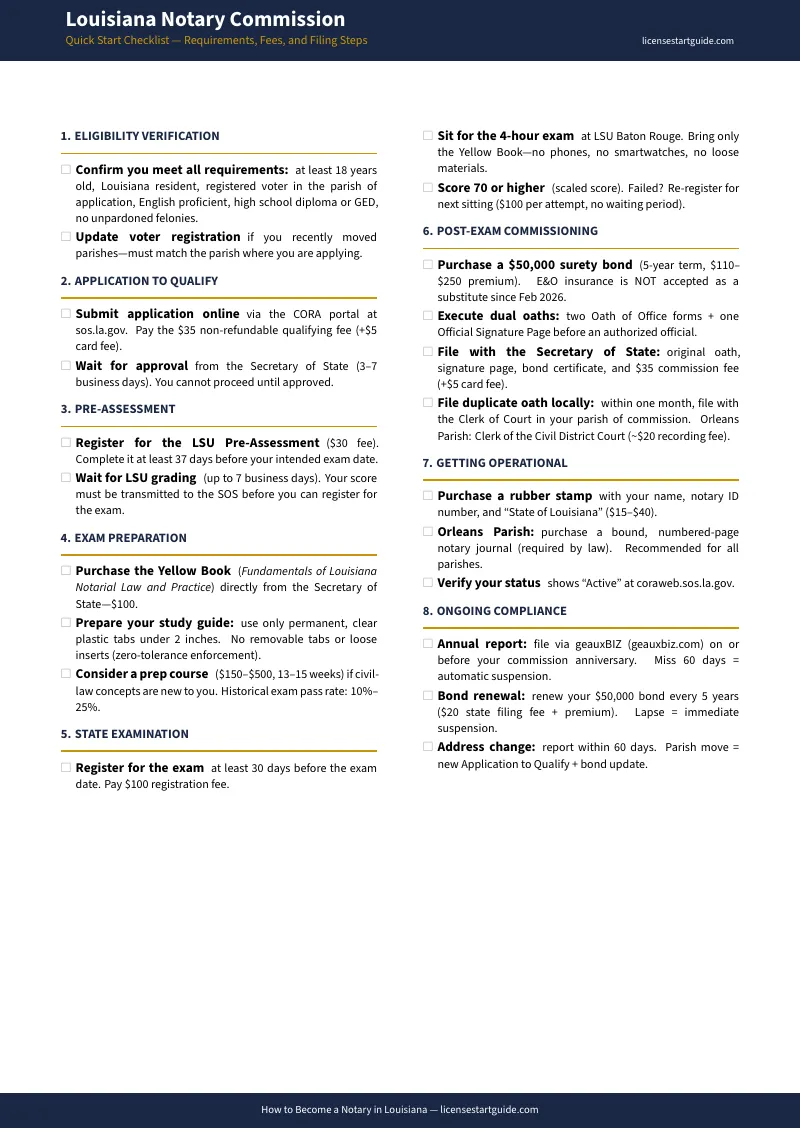
- checklist.pdf — A printable 20-item checklist that sequences every step from initial eligibility through your first notarial act, organized across 8 sections.
- filing-sequence-timeline-planner.pdf — A fillable deadline calculator where you write in your target exam date and count backwards to see every filing deadline in the pipeline.
- cost-budget-worksheet.pdf — Track estimated vs. actual costs through the full commissioning process, from the $35 application to the bond premium and optional supplies.
- exam-day-preparation-card.pdf — A one-page quick reference for exam day: testing details, what to bring, and the zero-tolerance tab and device rules that get people dismissed.
- bond-compliance-quick-reference.pdf — Print this when shopping for a bond: Act 258 changes, the four-item surety provider verification checklist, filing steps, and renewal schedule.
- post-exam-filing-sequence-card.pdf — The three-office, step-by-step filing tracker for after you pass: bond, oaths, Secretary of State, and parish clerk, with the critical one-month deadline.
- ron-authorization-checklist.pdf — The separate Remote Online Notarization setup track: training, vendor selection, registration, and operating requirements with the physical-presence rule.
- commission-maintenance-tracker.pdf — A lifetime tracker for annual report filings, five-year bond renewals, and parish transfer records.
Satisfaction Guarantee
If the guide doesn't help you navigate the Louisiana commissioning process more confidently, email [email protected] and we'll make it right.
Get Started
Download the free checklist to see how the Filing Sequence System works. When you're ready for the full guide — with the pre-qualification walkthrough, exam logistics, bond acquisition steps, dual-level filing instructions, UPL boundary map, and RON setup process — get the complete toolkit for .