
You Know How to Build — But Iowa's Compliance System Wasn't Designed to Be Navigated
You've spent years working with your hands — framing walls, pouring footings, running renovation crews. You're ready to go independent. You file your LLC with the Iowa Secretary of State and assume you're good to start bidding on jobs.
Then you discover the state requires a separate DIAL registration. And DIAL won't process your application without a myIowaUI unemployment insurance number — even though you have zero employees. Meanwhile, the city where your first project sits wants a surety bond that's completely separate from anything the state requires, and the amount varies by jurisdiction. Des Moines wants $5,000. Davenport wants $25,000. And that $500 penalty for working unregistered? It jumps to $5,000 on a second offense.
The information exists across a dozen different websites — DIAL, the Secretary of State, Iowa Workforce Development, five different city building departments — but nobody has assembled it into one sequence you can follow from start to finish.
The Iowa Contractor Compliance Roadmap
This guide maps the entire path from business formation to your first pulled permit, connecting every agency touchpoint in the correct order so you never discover a missing prerequisite mid-project.
Most contractors piece together compliance information from state portals that don't reference each other, national licensing sites that don't know Iowa uses registration instead of licensing, and bond brokers who explain their product but not the rest of the process. The Iowa Contractor Compliance Roadmap gives you a single document that covers every state and municipal requirement in sequence — including the steps that trip up experienced contractors because they look optional but are actually blocking.
What's Inside
- The Full DIAL Registration Walkthrough — every field on the application explained, including the workers' comp exemption box that causes 30-day delays when checked incorrectly
- The myIowaUI Account Setup — how to create the unemployment insurance account that DIAL requires before it will process your application, including the non-liable pathway for businesses with no employees
- The $50 Fee Exemption Process — the notarized form that saves solo operators and single-member LLCs the annual registration fee, with the three disqualifying conditions spelled out so you don't file incorrectly
- City-by-City Permitting Directories — Des Moines, Cedar Rapids, Davenport, Sioux City, and Bettendorf, each with their specific contractor license requirements, bond amounts, online portal instructions, and permit thresholds
- Insurance and Bond Requirements Decoded — how workers' compensation, general liability, and surety bonds interact at the state and municipal levels, and the $25,000 out-of-state contractor bond that catches border-state crews off guard
- Specialty Trade License Coordination — when a DIAL registration alone isn't enough, covering the Plumbing and Mechanical Systems Board, Electrical Examining Board, and DNR well contractor certification, including exam logistics and triennial renewal cycles
- 6 Printable Worksheets and Trackers — a registration sequence tracker, municipal licensing comparison, insurance and bond tracker, renewal calendar, startup cost worksheet, and fee exemption qualifier — all fillable, all ready to print
Who This Is For
- Solo operators and trade remodelers transitioning from employee status to running their own residential construction business in Iowa
- Multi-craft contractors who need to coordinate DIAL administrative registration with specialty trade licenses from the PMSB or Electrical Examining Board
- Out-of-state commercial crews entering Iowa from Nebraska, South Dakota, Illinois, or Minnesota who need to navigate the mandatory $25,000 surety bond and Iowa-specific compliance requirements
- Subcontractors going independent who need their own DIAL registration number to bid on work and pull local permits
Why Not Free Online Resources?
The official state portals are accurate but fragmented. DIAL doesn't explain how to navigate the Secretary of State's Fast Track Filing system. The myIowaUI system assumes you already understand employer accounts. Cedar Rapids runs permits through MYCR while Des Moines uses its own Permit and Development Center. National compliance sites like Harbor Compliance offer state-by-state overviews designed as lead-gen vehicles for their managed services — they rarely cover city-specific bond divisions or local permit thresholds.
Exam-prep companies market expensive study bundles for Iowa without clearly stating that general contracting in Iowa requires no state-level exam. Surety bond brokers explain their bond products but not the business formation steps that must come first.
This guide connects all of it — state business formation, DIAL registration, unemployment insurance, municipal licensing, bonds, insurance, and specialty trade coordination — in one document, in the right order, with every agency-specific requirement verified against current Iowa law and municipal ordinances.
Satisfaction Guarantee
If this guide doesn't save you time navigating Iowa's contractor compliance system, email us and we'll make it right.
Get Started
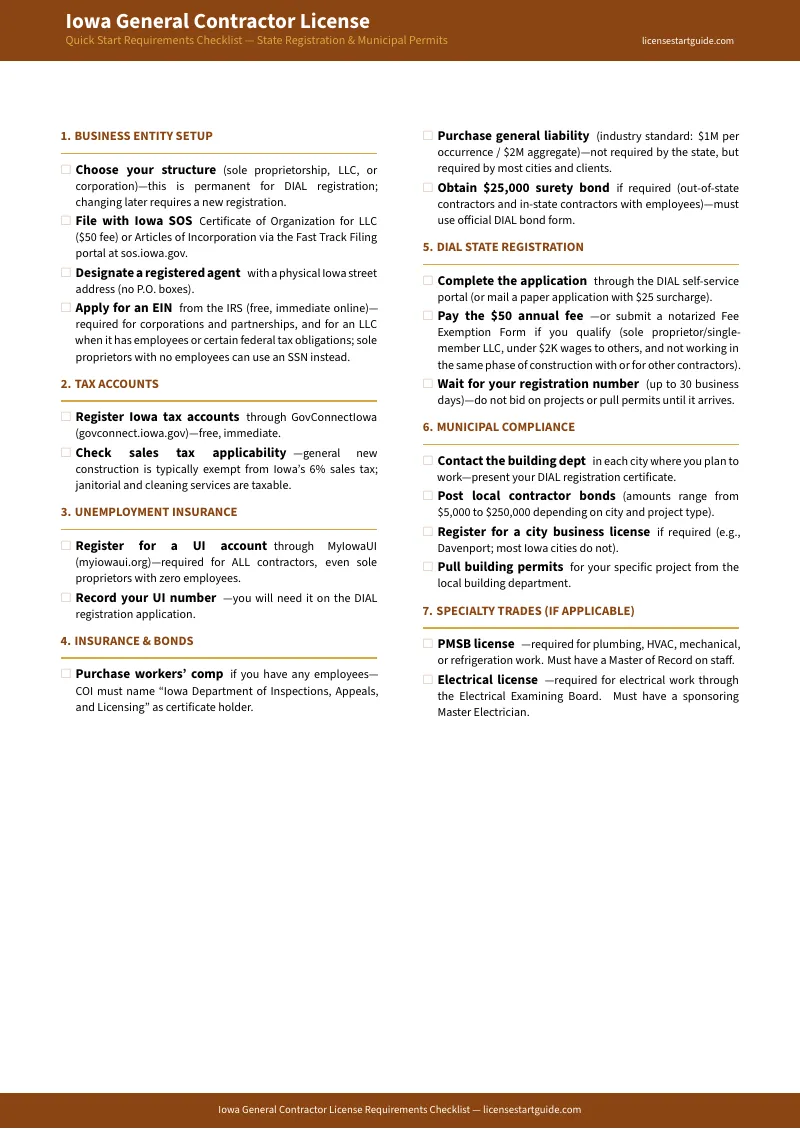
Download the free checklist to see the full state-to-local compliance sequence at a glance. Ready for the complete walkthrough with city-by-city directories, fee exemption instructions, and specialty trade coordination? Get the full guide for .