
Idaho doesn't require an exam. That doesn't mean it's simple.
No mandatory training, no state test, no county clerk filings — Idaho's notary process sounds straightforward until you're in the middle of it. You buy a surety bond before confirming your eligibility. You order a stamp from the first vendor that shows up on Google and get dimensions that don't match Idaho Code. You print your SOSbiz application on a Thursday, and by the time you find someone to notarize your oath and get the package to Boise, you've burned half of your 30-day filing window.
Meanwhile, every website selling notary supplies has a financial incentive to package things you don't need. The National Notary Association's Idaho packages start at $164. Notary Public Underwriters charges $129 for their standard bundle. Both include items the state never requires — and neither one walks you through the sequence of steps that actually determines whether your application sails through or gets rejected.
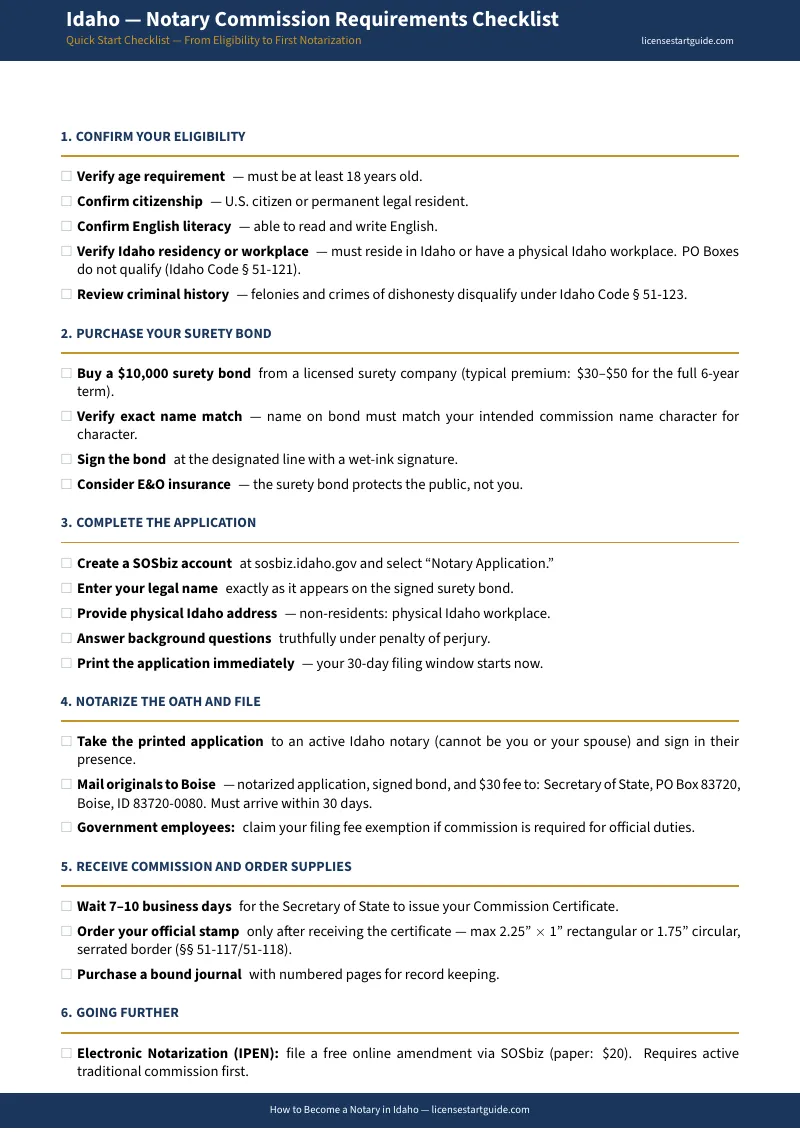
The Idaho Notary Filing Sequence is an independent guide that puts every commissioning step in the right order — verify eligibility, source the bond, file the application, get the oath notarized, mail the packet, buy supplies — so you clear each gate before spending money on the next one. No supplies sold, no vendor partnerships, no upsells. Just the regulatory steps in sequence, with the decision points and cost traps flagged before you hit them.
What's Inside
- Eligibility pre-screen — residency rules (including the non-resident exception for Idaho-based workplaces), citizenship, age, and the disqualification categories under Idaho Code § 51-123. You confirm you qualify before paying for anything.
- Bond sourcing without the markup — what the $10,000 surety bond actually covers (the public, not you), how to compare six-year premiums from licensed carriers, and the separate bond path for state employees through the Department of Administration's Risk Management Program
- SOSbiz application walkthrough — account creation, the application form, and the single decision that costs applicants an extra $20: filing on paper instead of online. Includes the government employee fee exemption and how to document it.
- The 30-day filing window — after you print the application, the clock starts. The guide maps out a realistic timeline for getting the oath notarized, assembling the package, and getting it to Boise before the deadline expires and your fee is forfeited.
- Oath of office logistics — how to find an active Idaho notary to administer your oath, what to bring, and the signature-matching rules between your application, oath, and bond that trip up first-time applicants
- Stamp compliance — Idaho's exact dimensional requirements (rectangular max 2.25 × 1 inch, circular max 1.75-inch diameter), the mandatory text elements, and the prohibited elements that get documents rejected at county recorder offices
- Journal best practices — what to record, which personal identifiers to leave out, and how a voluntary journal becomes your best liability shield when a notarized document is challenged years later
- Remote online notarization roadmap — the training requirement, platform evaluation criteria, the Statement of Compliance process, the $20 filing fee, and the 10-year video storage obligation under IDAPA 34.07.01
- Mobile notary business setup — Assumed Business Name filing, local business permits, the $5 statutory fee cap under Idaho Code § 51-133, and where the line falls between mobile notary services and unlicensed escrow activity under the Independent Escrow Act
- Renewal and maintenance — the six-year commission cycle, name and address change procedures, and the events that void your commission immediately
- 9 fillable worksheets — eligibility screening, bond comparison, application tracking, commission cost breakdown, stamp compliance verification, RON platform evaluation, notary journal page, name-match verification protocol, and 30-day filing tracker
Who This Is For
Administrative professionals whose employers need a notary on staff. You need to get commissioned without delays or rejected paperwork, and you want to know whether your employer should cover the bond, the fee, or both — and whether the government employee exemptions apply to your situation.
Real estate and title workers who handle closings, deeds, and mortgage documents. You need a commission to keep transactions moving, and you want to understand the boundary between notarization and activities that require a licensed escrow agent under Idaho law.
Legal support staff — paralegals, legal assistants, court runners — who handle affidavits and depositions. You need compliant stamp placement and certificate formatting, and you may need the apostille submission process for documents going overseas.
Side-business starters building a mobile notary or RON practice. You want to evaluate the technology investment and fee structure before committing, and you need to separate state requirements from private certifications like loan signing agent credentials.
Why Not Just Use the Free Information?
The Idaho Secretary of State's website has the statutes, the administrative rules, and isolated PDF manuals — but it doesn't tell you what to do in what order, and it can't advise you on how to compare private bond providers or avoid vendor markups on supplies. It's dry legal text, not a step-by-step process.
Commercial sites are worse. At least one major vendor still advertises a $5,000 bond requirement and a four-year commission term — both are wrong. The correct figures are a $10,000 bond and a six-year term, and an applicant who follows that outdated advice files a non-compliant bond and gets rejected.
This guide is completely independent. It doesn't sell stamps, doesn't write bonds, and doesn't have a vendor relationship. It puts the steps in the right order, flags the cost traps and compliance errors before you hit them, and gives you the complete cost breakdown — so you spend money on what's legally required and nothing else.
Satisfaction Guarantee
If the guide doesn't give you a clear, actionable path to your Idaho notary commission, email us and we'll refund your purchase. No forms, no waiting period.
Get Started
Download the free checklist for the high-level commissioning steps, or get the full Idaho Notary Filing Sequence for — the complete guide plus 9 fillable worksheets covering eligibility screening, bond comparison, application tracking, commission costs, stamp compliance, RON platform evaluation, notary journal pages, name-match verification, and a 30-day filing tracker.