Idaho's licensing process isn't hard — it's out of order
You've put in the hours. You've done the work. Now you need the credential — and the state makes it surprisingly easy to lose months of progress on a procedural mistake you didn't know existed.
Idaho requires you to pass your trade exam before you submit your license application. Get that sequence backward and DOPL rejects your packet. Work a single shift while your apprentice registration is lapsed, and every hour from that gap is permanently voided — no appeals, no exceptions. Show up to PSI with your NEC tabbed with sticky notes instead of hole-punched and bound in a 3-ring binder, and they turn you away at the door.
The state website has the forms. Trade schools sell $200–$600 exam prep packages. Neither one gives you the operational sequence — the step-by-step order that gets you from where you are now to a license in your hand without a rejected application, voided hours, or wasted fees.
The Sequential Navigation Blueprint
This is a process navigation toolkit — not an exam prep course, not a study guide, not a collection of state forms you can download for free. The Idaho Electrician License Guide maps every licensing pathway in the exact order DOPL and the Idaho Electrical Board require, so you stop guessing which step comes next and start moving through the process with confidence.
It covers apprentice registration through journeyman through master through contractor licensing, updated for Idaho's 2025 elimination of continuing education and the transition to biennial birthday-based renewals.
What's inside
- The exam-first application sequence — the chronological workflow that prevents the most common rejection: submitting your DOPL application before passing your PSI exam
- OJT hour audit system — how to verify your registration was continuously active for every hour you logged, catch "dead zones" before DOPL does, and handle the diversity distribution requirement across residential, commercial, and industrial categories
- Both journeyman pathways mapped side by side — the 8,000-hour schooling track (576 classroom hours through CWI, CSI, NIC, or ISU) and the 16,000-hour experience-only track, with documentation standards for each
- Work Verification Form walkthrough — what DOPL actually checks, how to handle former employers who refuse to sign, and how to avoid the 75% single-category rejection
- PSI exam logistics and reference rules — scheduling, candidate ID setup, the open-book format, and the binding requirements that disqualify loose pages, sticky notes, and temporary tabs
- Journeyman-to-master advancement — the four-year experience requirement, the HB 153 dual-licensure renewal rule, and the master exam through PSI
- Contractor licensing sequence — entity formation with the Secretary of State, the $300,000 general liability insurance minimum, the contractor business and law exam, and the critical difference between DOPL electrical licensing and State Contractors Board registration
- State-versus-local permit jurisdiction map — which cities run their own electrical permitting (Boise, Meridian, Coeur d'Alene) and where DOPL handles it through eTRAKiT, why a building permit doesn't cover electrical work, and homeowner self-permitting rules
- Reciprocity and out-of-state transfers — the 12-state journeyman reciprocity list, Wyoming-only master reciprocity, the non-reciprocal state verification process, and military service credit
- 2025–2026 regulatory updates — the CE elimination, the biennial birthday-based renewal transition, updated fee schedules, and the changes most online guides still get wrong
- 5 printable planning worksheets — OJT tracking log, application document checklist, agency communication log, renewal timeline tracker, and a permit jurisdiction flowchart — each a standalone fillable PDF you can print and use at your desk or on the job site
Who this is for
- Apprentices preparing to test for journeyman — you need to audit your hours, verify your registration history, and navigate the exam-first application process without losing time or money to procedural mistakes
- Experienced workers without formal schooling — the 16,000-hour experience-only pathway has stricter documentation requirements and different verification standards than the schooling track
- Journeymen advancing to master — the four-year experience requirement, the master exam, and the HB 153 dual-licensure renewal changes that most guides don't cover yet
- Out-of-state electricians moving to Idaho — reciprocity waives your experience documentation but not the exam, and if your state isn't on the list, you need the full verification pathway
- Electricians starting a contracting business — contractor licensing is a separate credential from your electrician license, with a separate board, separate exam, and insurance requirements
Why not just use the free resources?
The DOPL website has every form you need. What it doesn't have is the sequence. The state's portal is an archive of static PDFs, board minutes, and administrative rules scattered across separate pages for each license type. Nothing tells you which form to submit when, which agency handles which step, or what order prevents a rejection.
Commercial test-prep companies sell exam preparation packages for $200–$600. Those packages teach you how to pass the test — but they don't tell you that you need a candidate ID from DOPL before you can schedule with PSI, that your reference materials must be bound in a specific format, or that your license application can only be submitted after you pass. Several of the most popular commercial sites still list continuing education as a renewal requirement for Idaho — it was eliminated in 2025.
This guide does one thing: it gives you the complete operational sequence from registration through licensure through renewal, with the administrative traps flagged before you hit them.
Satisfaction guarantee
If the guide doesn't save you time navigating the licensing process, email [email protected] and we'll refund your purchase — no forms, no waiting period.
Start with the free checklist or get the full guide
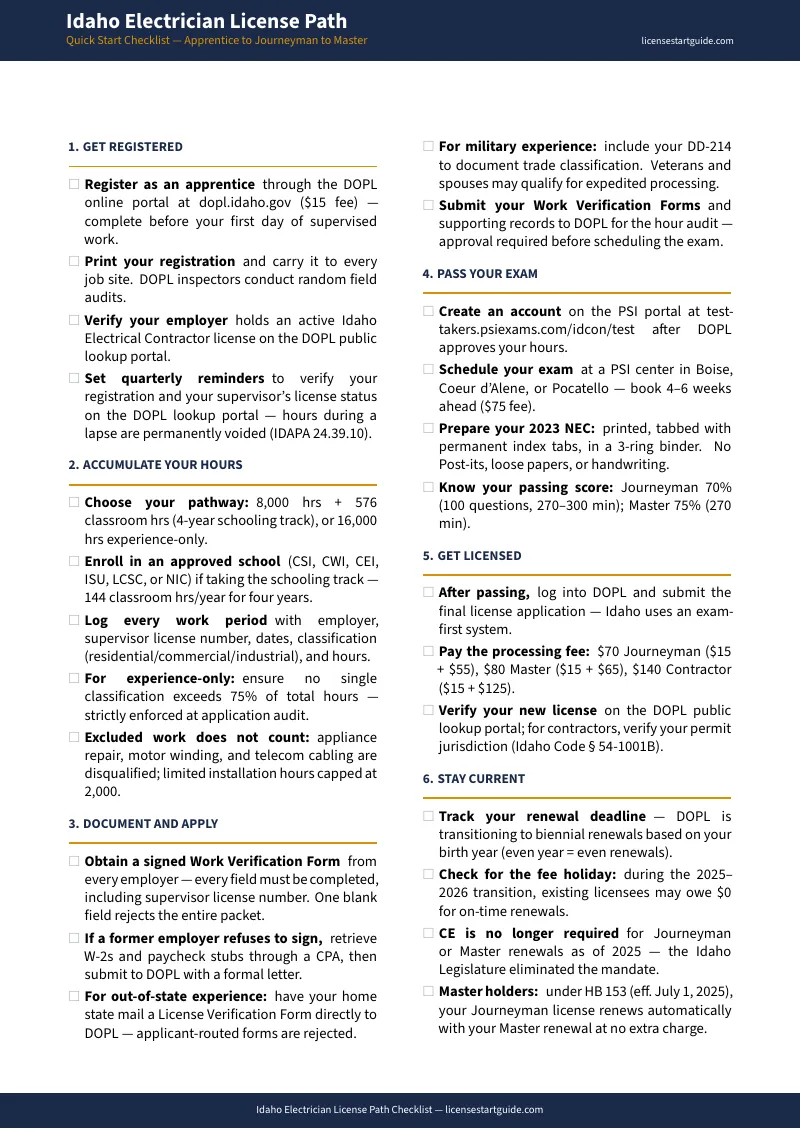
The free checklist gives you 25 action items across six licensing phases — enough to see the full process at a glance. The complete kit adds a 47-page guide with 13 chapters of detailed process navigation, 5 printable planning worksheets, and the 2025–2026 regulatory updates that the checklist can't cover.
For less than the cost of a single DOPL processing fee, you get the operational roadmap that protects your career timeline and keeps a rejected application from costing you months.