You know you can sell food from home in Florida. You just don't know what happens if you get it wrong.
Florida's cottage food law sounds simple: no license, no inspections, no permit. Make food at home, sell it directly to customers, and keep up to $250,000 a year in gross sales. But the moment you look at the details — which recipes actually qualify, whether your HOA can shut you down, what goes on the label and in what order, whether you need to collect sales tax on cookies sold at a farmers' market — the simplicity disappears.
The official FDACS website explains the food chemistry. Facebook groups give you conflicting advice about revenue caps and shipping rules. And nobody in either place tells you about the Business Tax Receipt your county requires, or the fact that your homeowner's insurance doesn't cover a single product liability claim from your kitchen.
Meanwhile, every week you wait is a week of sales you're not making — or worse, a week of sales you're making without knowing whether your labels, your recipes, or your delivery setup actually comply.
The Cottage Food Compliance System
This isn't another "overview of the cottage food law." It's a structured compliance system that walks you through every requirement in order — from verifying your recipe eligibility to setting up your business entity, labels, tax registration, insurance, and sales channels — so you clear each gate before spending money on the next one.
Where free resources scatter requirements across multiple agency websites, this guide puts the rules from FDACS, DBPR, the Department of Revenue, your county tax collector, and Florida's home-business statute (§ 559.955) into a single timeline. You work through it once, and you know exactly where you stand.
What's Inside
- Recipe Eligibility Worksheet — a fillable one-recipe sheet that tells you whether your specific product qualifies as a non-potentially-hazardous cottage food, with clear examples of where the line falls (buttercream frosting: allowed; cream cheese frosting: prohibited; sourdough bread: allowed; sourdough with fresh herbs: gray area that requires FDACS guidance)
- Label Builder Worksheet — fill-in fields for the exact information required by F.S. § 500.80(3) in the exact order the statute specifies, including the verbatim disclaimer text, the 10-point font minimum, and allergen declarations following federal standards
- Sales Channel Compliance Worksheet — which channels are legal (direct-to-consumer, farmers' markets, online orders with in-state delivery), which are explicitly prohibited (wholesale, consignment, out-of-state shipping), and where the gray areas are (third-party delivery apps, popup events at commercial venues)
- Gross Sales Tracking Worksheet — a weekly landscape log, because the $250,000 cap is calculated on gross receipts (including shipping fees and collected sales tax), not net profit, and miscounting can cost you your exemption mid-year
- County BTR Application Tracker — how to find out whether your city or county requires a local Business Tax Receipt, what the application process involves, and what additional documentation renters need (landlord permission letters, lease copies, and in some jurisdictions, background checks)
- HOA & Zoning Constraint Worksheet — how Florida's state preemption protects you from local government bans but does nothing about your HOA covenant, condo declaration, or rental lease — and a place to record the clauses that still bind you
- Insurance & Entity Setup Tracker — when and how to register a fictitious name on Sunbiz, whether an LLC makes sense for your operation, and what product liability insurance actually costs (typical quotes start around $299/year through providers like FLIP)
- Sales Tax Decision Worksheet — Florida exempts most grocery-food items from sales tax, but items sold for immediate consumption (served hot, with utensils, or eaten on-site) are taxable, and the rules for farmers' market samples aren't obvious
- Commercial Transition Planner — the exact triggers that push you out of cottage food territory (exceeding the cap, selling wholesale, manufacturing regulated products), which of Florida's three food-safety agencies handles your license type, and what the plan review, fees, and food protection manager certification involve
- Batch & Ingredient Log — a landscape batch sheet so you can match ingredients and allergens to the week you sold them if FDACS asks after a complaint
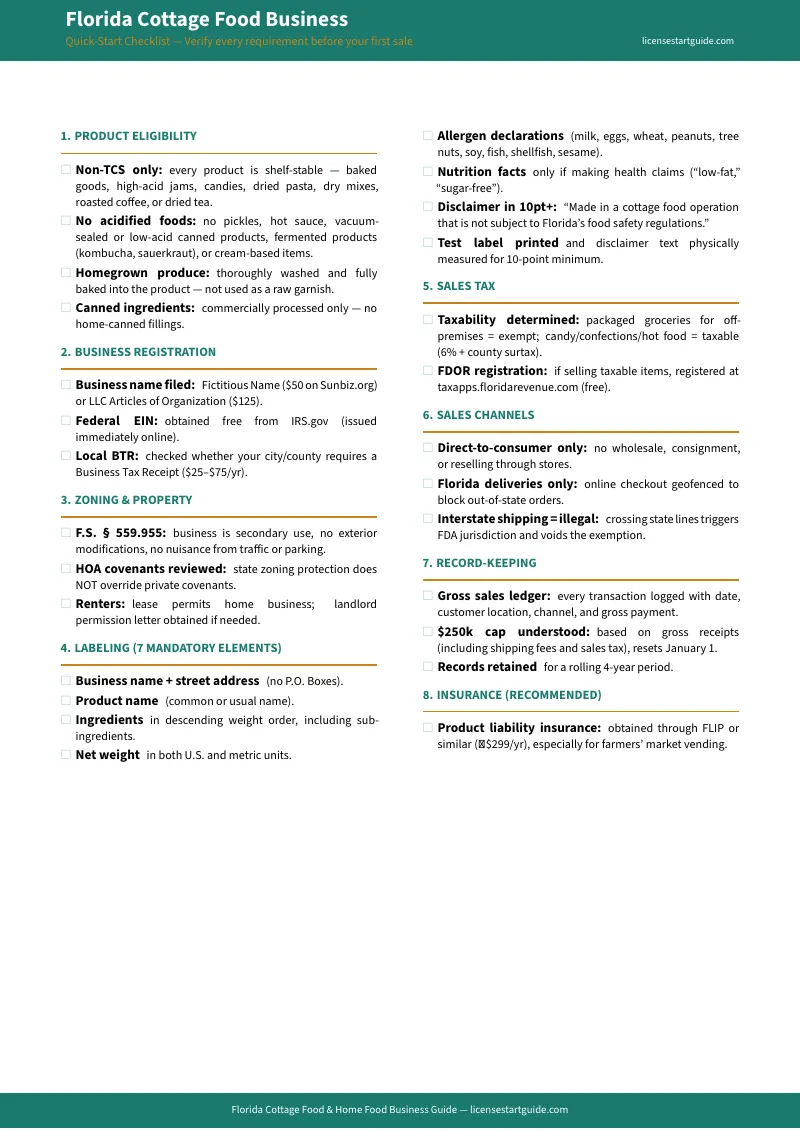
- 20-item startup checklist — every step from recipe verification through your first legal sale, sequenced so you don't waste time or money on steps that depend on earlier ones
Who This Is For
- Home bakers and makers who want to sell cookies, breads, jams, candies, or dry mixes from their residential kitchen and need to know exactly which recipes qualify before investing in packaging and labels
- Online and social-media sellers who take orders through Instagram or Facebook and need to configure their checkout to block out-of-state orders, understand the in-state shipping rules from the Home Sweet Home Act of 2021, and avoid creating a digital paper trail of non-compliant sales
- Farmers' market vendors who need to understand venue-specific requirements — product liability insurance, label reviews, sampling rules — that go beyond what the state cottage food law requires
- Growth-stage sellers approaching the $250,000 cap or wanting to expand into wholesale, restaurant supply, or refrigerated products who need a clear map of the commercial licensing transition
- Renters and HOA residents who need to navigate landlord permission letters, municipal BTR applications, and HOA boards that push back on customer traffic
Why Not Piece It Together From Free Resources?
You absolutely can. FDACS publishes food safety guidance. The UF/IFAS Extension office has brochures. Forrager and CottageFoodLicense.com maintain free state law summaries. These are accurate sources — and this guide cites many of them.
But here's what those free resources don't cover:
- FDACS explains food chemistry. It doesn't tell you how to get a Business Tax Receipt in Miami-Dade County, where you need a Certificate of Use for Home Occupation and your kitchen use is capped at 500 square feet.
- Online guides explain the $250,000 cap. They don't explain that gross receipts include shipping fees and collected sales tax — or that failing to track weekly can cost you your exemption mid-year.
- Facebook groups share labeling tips. They don't mention that the statutory disclaimer must be in at least 10-point font in a contrasting color, or that P.O. boxes aren't allowed on your label — you must list your physical home address.
- National cottage-food sites cover Florida's rules. They don't cover the split between DBPR (restaurants, food trucks, caterers) and FDACS (commercial bakeries, wholesale packaging) when you're ready to scale beyond the exemption.
The guide doesn't replace those resources — it organizes them into a single compliance timeline so you're not spending your first three weeks of business researching instead of selling.
Satisfaction Guarantee
If the guide doesn't save you time and confusion navigating Florida's cottage food requirements, email us and we'll refund your purchase — no questions asked.
Start With the Free Checklist or Get the Full Guide
The free checklist gives you a quick eligibility check — 20 items covering the core cottage food requirements so you can verify whether your recipe, kitchen, and sales plan meet the basics. Download it, work through it tonight, and see where you stand.
When you're ready for the full compliance system — Label Builder Worksheet, County BTR Application Tracker, HOA & Zoning Constraint Worksheet, Sales Tax Decision Worksheet, Commercial Transition Planner, and tracking worksheets — get the full guide for .