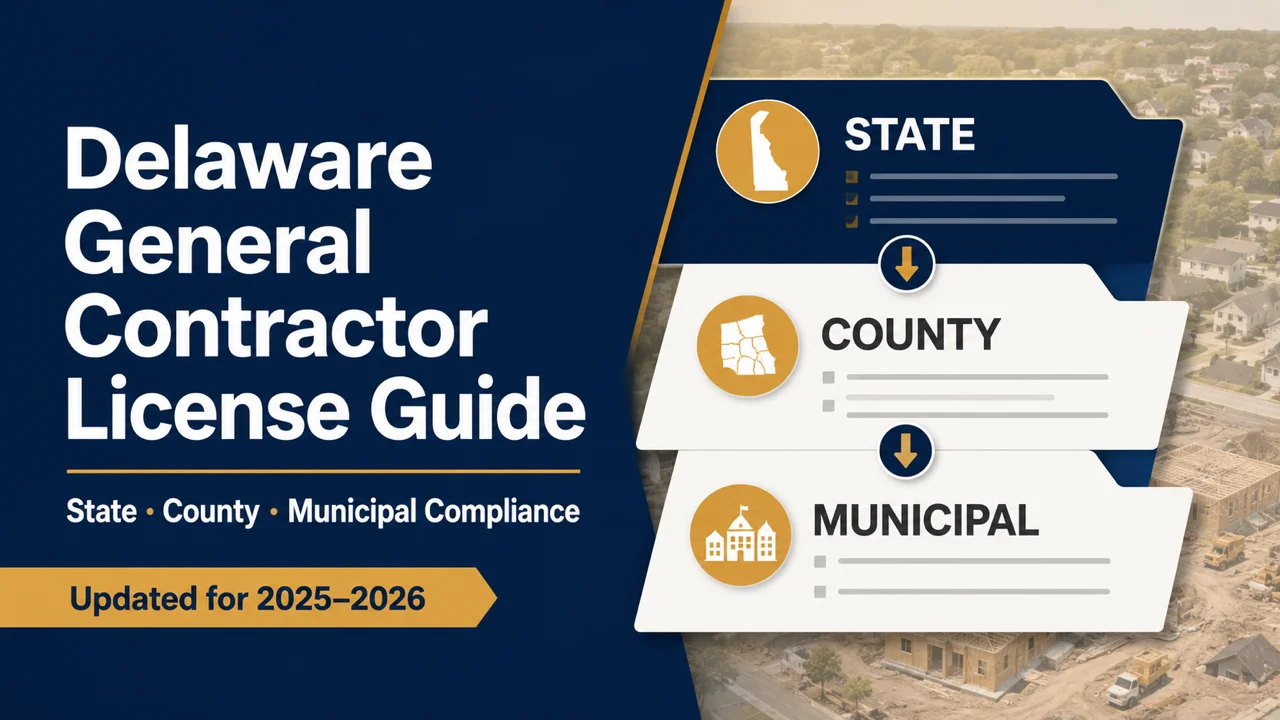
Five Agencies, Three Counties, Six Cities — One Sequence That Handles All of Them
You know how to build. What you don't know is which of Delaware's overlapping agencies you need to register with first, which bonds each county demands, or what happens when a residential contract is missing the state-mandated disclosures.
Delaware doesn't issue a statewide general contractor license. Instead, it layers a Division of Revenue business license on top of a Department of Labor contractor registration on top of county permit-endorsed licenses on top of municipal business licenses — each with its own forms, fees, bond amounts, and renewal deadlines. Miss one layer and the whole sequence stalls: your permit applications get rejected, your project payments get withheld, or your residential contracts get declared void.
The Delaware General Contractor License Guide is a Multi-Authority Compliance Map — a single-document sequence that routes you through every state, county, and municipal registration in the right order, so you handle each agency once and move on. No managed filing service, no recurring subscription, no affiliate upsells. Just a plain-language process manual with direct links to every official portal, form, and filing page you'll need.
What's Inside
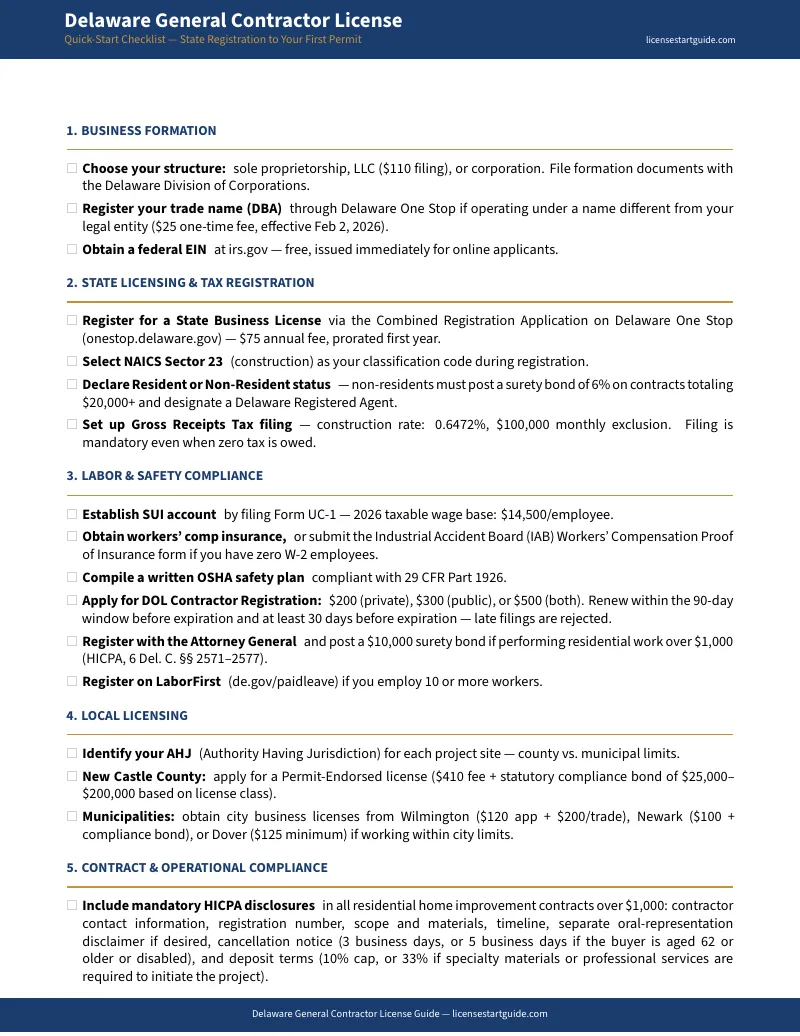
- Division of Revenue business license walkthrough — the $75 annual fee, first-year prorating rules, the senior discount, three-year renewal, and the February 2026 trade name transfer to Delaware One Stop, so you don't file a DBA application with the wrong office
- Gross Receipts Tax setup from scratch — the 0.6472% construction rate, the $100,000 monthly exclusion, Form 1280 and Form 1280-DEV for subcontractor deductions, and the materials-only trap that catches contractors who try to deduct supply purchases
- Department of Labor contractor registration — the $200/$300/$500 fee tiers, the OSHA safety plan that gets applications rejected when it's incomplete, the strict 30-day renewal window, and the two-year discounted renewal most contractors don't know exists
- HICPA residential compliance decoded — the $1,000 contract threshold, the 10% vs. 33% deposit cap, mandatory three-day and five-day cancellation rights, and the $10,000 surety bond requirement, because a single missing disclosure can void your contract and kill your mechanics' lien rights
- New Castle County permit-endorsed licenses — Classes U, A, B, and C with bond amounts from $25,000 to $200,000, the $410 combined fee, insurance minimums, and the July 2026 credit card surcharge
- Kent County permitting — the new Ordinance 25-25 drainage standards, the half-acre survey mandate, and the MyGovernmentOnline portal submission process
- Sussex County permitting — the 400-square-foot placement permit threshold, the 5,000-square-foot sediment control plan requirement, and FEMA coastal overlay rules for coastal builds
- Wilmington, Newark, and Dover municipal layers — Wilmington's head tax ($15/month per employee beyond five), Newark's compliance bonds with a three-year code warranty, and Dover's receipts-based fee calculation
- Non-resident contractor compliance — the mandatory 6% surety bond for contracts of $20,000+, the registered agent requirement, and the withholding penalty you trigger by showing up unregistered
- Seven printable planning tools — the State Registration Tracker, the Local Jurisdiction Mapper, the Bond and Insurance Inventory, the Subcontractor Verification Log, the Renewal Calendar Planner, the HICPA Contract Compliance Checklist, and the Gross Receipts Tax Filing Worksheet, so every filing, fee, bond, and deadline stays on paper instead of in your head
Who This Is For
This guide is for experienced construction workers stepping out on their own, out-of-state contractors from PA, MD, or NJ entering Delaware's market, and established builders expanding into structural work that triggers county permits. It covers the administrative process — not exam prep, not trade skills, not a managed filing subscription.
Why Not Just Use the Free Government Websites?
Because there is no single government website. Delaware's contractor requirements are scattered across the Division of Revenue, the Department of Labor, the Attorney General's Consumer Protection Unit, the Division of Professional Regulation, three separate county building departments, and at least three major municipal licensing offices. Each maintains its own portal, its own forms, and its own fee schedules. Harbor Compliance and Bryant Surety Bonds cover parts of the picture, but their content exists to sell managed filing packages and surety bonds — not to give you a self-filing sequence. The state's own Delaware One Stop portal handles tax and labor registrations, but it doesn't touch county permits, municipal licenses, or HICPA compliance. This guide connects every layer into one ordered sequence.
Satisfaction Guarantee
If the guide doesn't save you time navigating Delaware's contractor licensing process, email us and we'll refund your purchase. No forms, no hassle.
Get Started
Download the free Delaware General Contractor License Requirements Checklist to see what's ahead. When you're ready for the full process map — with every form, fee, bond amount, and portal link laid out in order — get the complete guide for .