The state gives you forms. It doesn't tell you what order to file them in.
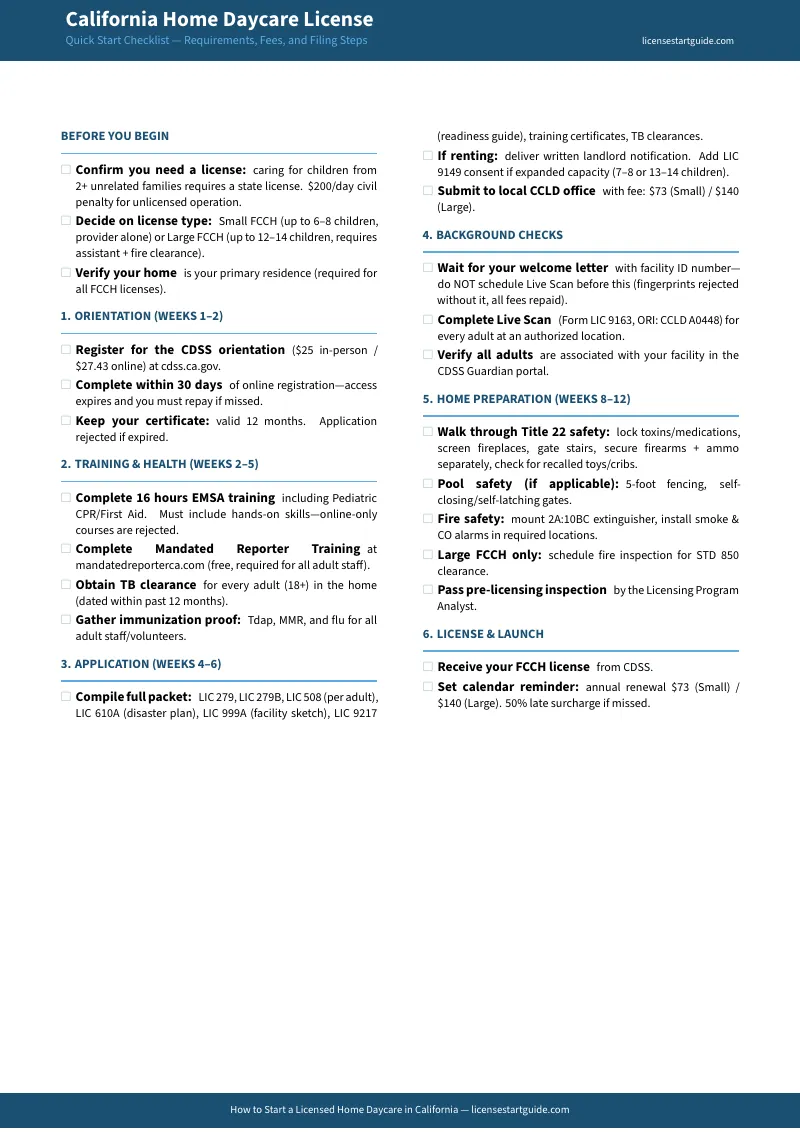
California's Community Care Licensing Division publishes every form, regulation, and fee schedule you need to open a family child care home. What it doesn't publish is a sequence. So prospective providers register for orientation, then complete their Live Scan fingerprints before receiving a facility identification number — and the Department of Justice rejects the results. They pay the fees again, schedule another appointment, and lose two to four weeks before their application even moves.
That's one mistake in a process full of them. The 30-day orientation expiration clock starts the moment you register. Miss it and your access expires — you register and pay again. Complete the home inspection prep without Form LIC 9217 as your self-audit tool and a single unlocked cabinet or unvented gas heater fails you. Choose between a small and large license without understanding the age-mix capacity rules and you're either leaving revenue on the table or hiring an assistant you don't need yet.
The California Licensing Sequence Guide maps the entire process — from orientation registration through your first day of care — in the exact order that avoids rejected paperwork, duplicate fees, and inspection failures.
What's Inside
- Six-step licensing sequence — orientation, application assembly, Live Scan clearance, EMSA training, home inspection, and license issuance, ordered so each step triggers the next without dead time. The guide flags the specific points where doing things out of sequence costs you money or weeks of delay
- Live Scan timing walkthrough — why you must wait for your facility identification number before scheduling fingerprints, what goes on Form LIC 9163 and the ORI code (CCLD A0448), and how the Guardian background check system processes clearances for you, your household adults, and any assistant
- Small vs. large license decision framework — capacity limits, age-mix thresholds, the experience requirement for large homes, fire marshal clearance via Form STD 850, assistant staffing rules, and fee comparisons — so you pick the right license type before you apply, not after
- Room-by-room home inspection prep — the physical safety standards your Licensing Program Analyst checks during the pre-licensing visit, organized as a self-audit using Form LIC 9217. Covers the items that cause immediate failure: accessible cleaning products, unlocked firearms, unvented gas heaters, pool and water hazards, and outdoor play area fencing
- Tenant and HOA protections — Senate Bill 234 makes family child care a residential use of property and voids restrictive lease clauses. The guide includes the notification forms, statutory references, and response language for landlord objections — because most tenants assume they need permission when the law says they don't
- Capacity and age-mix calculator — the exact rules for reaching 7–8 children (small) and 13–14 children (large), infant limits, how your own children count during operating hours, and the consent conditions that unlock maximum capacity
- Subsidy enrollment walkthrough — how to become an approved provider for the California Alternative Payment Program and CalWORKs vouchers, county processing steps, and the administrative moves that prevent payment delays from disrupting your revenue
- EMSA training requirements — the 16 hours of mandatory health, safety, and nutrition coursework, how to find EMSA-approved providers, and what the state actually requires versus what commercial training companies upsell
- Ongoing compliance reference — annual inspection expectations, incident reporting, record-keeping obligations, citation categories, and the renewal process so you don't just get licensed — you stay licensed
- Complete fee reference — every state fee from orientation through annual renewal, broken out by small and large license, so you can budget the full startup before committing to the process
Who This Is For
Parents leaving a traditional job who want to generate income while caring for their own children at home. You've never dealt with a state licensing agency, and the CDSS website gives you a wall of regulations without a clear starting point. This guide sequences every step so you're not guessing what comes next or discovering a missing requirement after you've already paid fees.
Informal caregivers going legal — you've been watching a neighbor's kids, a second family just asked, and you know that caring for children from more than one family without a license carries civil penalties of $200 per day in California. The guide walks you through formalizing your operation, including background clearances for every adult in your household.
ECE professionals opening a home-based business — you know Title 22 from working in a center, but residential licensing has its own set of requirements around home safety modifications, local fire clearances for large capacity, and property-specific rules that center experience doesn't cover.
Tenants and renters whose landlord or HOA says they can't operate a home business. The guide covers Senate Bill 234's protections for family child care operators and gives you the notification process and statutory citations that address those objections.
Licensed small providers expanding to large capacity — the large license requires a new application, proof of prior experience, a fire marshal inspection, and an assistant. The guide maps the expansion so you can time it without interrupting your current operations or your families' care arrangements.
Why Not Just Use the Free State Resources?
Because the state resources tell you what's required. They don't tell you what order to do it in — and the order is where most applicants fail.
The CDSS website publishes every form and regulation, but it's scattered across dozens of pages without a chronological workflow. County Resource and Referral agencies offer free support, but availability varies by county and wait times for appointments can eat into your 30-day orientation window. National daycare checklists don't cover California's Title 22 regulations, EMSA training mandates, or the Guardian background check system. And commercial training companies charge hundreds of dollars for coursework packages when the state only requires 15–16 hours of specific EMSA-approved courses.
This guide doesn't sell training, doesn't sell insurance, and doesn't have a vendor relationship. It sequences the exact steps, flags the exact mistakes, and gives you the exact cost breakdown — so you spend your time and money on what's legally required and nothing else.
Satisfaction Guarantee
If the guide doesn't give you a clear, actionable path to your California family child care home license, email us and we'll refund your purchase. No forms, no waiting period.
Get Started
Download the free checklist for the high-level licensing steps, or get the full California Licensing Sequence Guide for — the 14-chapter guide plus 9 printable tools: quick-start checklist, room-by-room home safety audit, capacity and age-mix worksheet, fee calculation reference, compliance tracker, SB 234 landlord notification template, household background tracker, application document tracker, and startup cost worksheet.